To begin, none of my thoughts are meant to criticize all who work tirelessly to create a comprehensive music education system and inspire our young people. These are my own observations, and I hope they lead to more discussions.
I recently read this quote from an article titled “The Musical Status of the Band,” written by Mark H. Hindsley in 1946 for the Music Educators Journal. The quote, shortened for brevity, addresses criticisms against wind bands by an esteemed musicologist of the time:
In spite of Gilmore, Innes, and Sousa, and in spite of the galaxy of their successors and disciples, we have not been able to dispel the popular conception of bands as the marching semi-concertizing groups that have stuck closely to the more common earlier band traditions…these were the main accusations against the band [given by a musicologist at a lecture]; (1) The band is an outdoor organization, too vigorous and noisy to play indoors…
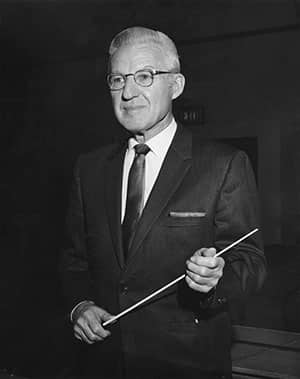
Mark H. Hindsley
When I read Hindsley’s article, I wondered if the criticism that “band is an outdoor organization, too vigorous and noisy to play indoors” is one we still face eighty years later. While some criticisms outlined in the article are dated and have been rectified, I believe the one mentioned above is more relevant today than ever.
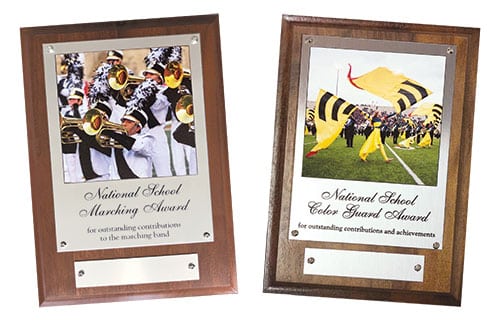
There is a deepening issue in the band movement that concert bands and their repertoire are increasingly driven by the marching arts. This is a trend I have observed for the last several years, if not longer. Attending the last four CBDNA conferences, I have noticed how loud and effect-driven ensemble performance and repertoire has become. Recently at the CBDNA Southern Division, there were moments during each concert I attended when I had to plug my ears due to the volume and aggressiveness of the ensemble’s performance, which also reflects the compositional vocabulary of the repertoire. Historically, marching bands would draw on concert repertoire for their show design and performance. Over the last two decades, music for competitive marching shows has become its own compositional idiom, which has then driven some areas of concert band repertoire. This is maybe an influence on overall volume of concert band performances.
In addition to volume, I have noticed increased homogenization of current band compositional vocabulary. The idiomatic language of some of our most performed composers seems to closely resemble the compositional style of DCI and BOA shows. I repeatedly hear the same effects and styles across composers and grade levels to the point where I can play music bingo with these recurring idioms. Perhaps this reflects a larger social trend towards homogenization of culture, driven by algorithmic creation and trend chasing.
Kyle Chayka’s Filterworld: How Algorithms Flattened Culture is a captivating read on this topic. Our compositional world seems to be flattening, driven by trends of the outdoor performing ensembles, which in turn have cranked up the volume of our concert ensembles.
Counterintuitively, trends in the marching arts with amplification, mixing, and using pre-recorded material seem to be turning their volume down. Last November, I had the opportunity to accompany a local band program to a BOA Regional show, my first BOA show since 2017. During Finals, I noticed bands lining the home sidelines with an array of mics. I asked my director friends about it and learned of this trend where bands mic and mix the entire ensemble live. In addition, I had the opportunity to talk with someone deeply involved with BOA adjudication, and they shared stories of bands pre-recording their best musicians on certain arrival chords and having those sounds mixed into the speakers with the live performance sound.
They also commented that the shotgun mics allow bands to stay within certain dynamic levels and can boost impact moments through amplification, not acoustic dynamic changes. This was evident during Finals, when an ensemble lost power to their mixing board and lost all amplification for the rest of the performance. The difference between the pure acoustic sound level and their mixed production volume was astonishing, and this was a strong, competitive program that might have been around 150-200 band members.
Driving home that night, I felt like Rip Van Winkle, waking up and disoriented by a strange new world. I recognize that amplification is beneficial for certain instruments and soloists, and electro-acoustic samples can heighten the meaning of show design. I have a harder time understanding how micing the whole field and using pre-recorded audio of the best students serves music education (not to mention the astronomical costs for equipment, sound design and engineering).
I believe the band movement is undergoing a seismic shift. Concert ensembles are playing noticeably louder with repertoire that is informed by the marching arts, yet marching groups are using amplification and show design to control volume. Eighty years ago, Hindsley sought to address the criticism of bands playing too loudly, and yet today, those same issues continue to face the profession. I hope we can turn the volume down for our performances, reflect on current trends, and find a new way forward that elevates our performance medium. You can contact me at ibrinberg@augusta.edu with thoughts and questions. I welcome open discussion.
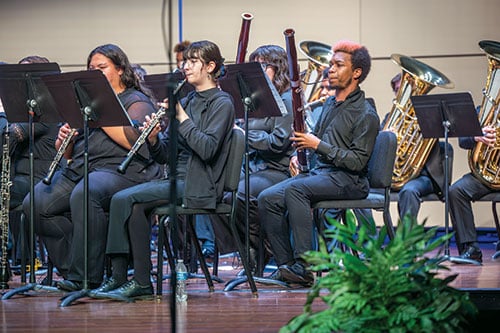
Augusta University Wind Ensemble