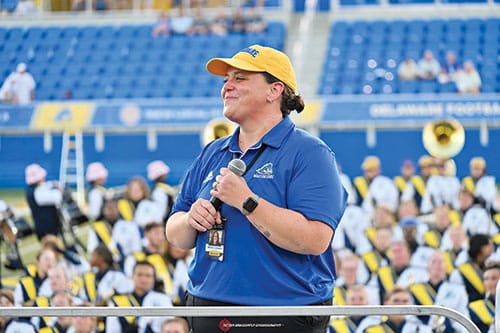
By most outward measures, I had achieved what I had spent years working toward. I had earned a Doctorate of Musical Arts, served as Director of Athletic Bands at a Division I university, and spent my days doing work I genuinely loved. My calendar was full of rehearsals, performances, travel, and meetings. I was busy in all of the ways that signal success in our profession. Like many band directors, I wore the long hours, late nights, and packed weekends as a badge of honor. Exhaustion was not a warning sign. It was proof of commitment.
Then, in the summer of 2023, I resigned.
This was not a dramatic exit, a rejection of the profession, or even a result of true band director burnout. It was a shifting of priorities, prompted by life circumstances and a growing awareness that the way I was working left little room for the rest of my life. Ultimately, my year away from the classroom reshaped how I think about teaching, leadership, and building a sustainable career in music education.
For many, being a band director is more than a job. It becomes identity, community, purpose, and validation all wrapped into one. The structure of the work reinforces this. Our schedules are dictated by rehearsals, performances, games, and competitions. Our sense of worth often feels tied to outcomes such as ensemble sound, student success, and public recognition. For years, I thrived on the intensity of the work and the depth of the relationships I formed. I loved the sense that what I did mattered deeply to the students in front of me.
What I did not question was the cost.
Over time, I accepted constant overextension as normal. Missed family events, postponed rest, and the persistent mental load that followed me home each night became part of the job. I was not unhappy, and I was not failing. I was functioning at a high level, but my life was increasingly out of balance in ways I had stopped noticing.
It took a major life change to disrupt that pattern.
In 2022, my husband and I made a decision that changed everything. After losing my mother-in-law to breast cancer when my daughter was only five months old, we agreed that life was too short to live so far away from family. I started making plans to leave the position I loved so that we could move back to my hometown. We sold our house, packed up our toddler and two dogs, and relocated. During the transition, my husband unexpectedly lost his fully remote job, and any sense of stability disappeared overnight.
By August, I was working in a corporate office as a billing specialist, a role that could not have felt further removed from my professional identity. It was necessary for our family, but the change was jarring. My days revolved around invoices and spreadsheets instead of score study and rehearsal plans. I had gone from directing a college marching band to clocking in and out while sitting behind a computer all day.
What surprised me most about this season of my life were the lessons I learned and how they ultimately made me a better band director.
Lesson 1: Loving the Work Does Not Guarantee Balance
I did not leave my teaching position because I felt angry or defeated. I left to prioritize family. Yet once I stepped away, I began to see how thoroughly my professional role had defined me. In music education, passion is both our greatest strength and our greatest vulnerability. We care deeply about our students and our programs. Over time, that commitment can quietly crowd out everything else. Before stepping away, I had normalized a constant mental load. Even at home, I was planning rehearsals, answering emails late at night, or writing marching band drill. I told myself the pace would ease after the next performance or season, but there was always another milestone ahead.
In my new corporate role, expectations were different. When the workday ended, I closed my laptop and was done for the day. For the first time in years, I ate dinner with my family every night. I put my daughter to bed without checking my phone. Weekends were no longer consumed by game days or travel. I attended weekly dinners with my parents, cheered at my nephews’ baseball games, and watched football on Sundays at my sister’s house. I stopped missing birthdays and holidays, and most importantly, I watched my daughter build deep relationships with her grandparents, aunts, uncles, and cousins.
This new schedule exposed how often I had allowed work to fill every available space simply because it could. Loving the work had not protected me from imbalance. It had disguised it.
When I returned to teaching, I approached my schedule differently. I began protecting personal time with the same seriousness that I protected rehearsal blocks. Excellence did not require exhaustion. It required clarity and intention.
Lesson 2: Expanding Your Identity Strengthens Leadership
One of the most difficult parts of stepping away was not learning a new job. It was losing the identity reinforcement that comes with standing on a podium. In the band room, feedback is immediate and tangible. You hear improvement. You see growth. You perform a concert and the audience applauds. In my corporate position, the work mattered, but it was measured differently. No one knew that I had a doctorate. No one knew about my previous work. My job did not come with applause, titles, or instant feedback. For the first time in my adult life, my sense of worth was no longer strengthened by my profession. Without those familiar markers, I faced a challenging question: Who am I when my job is no longer my primary source of validation?
During that year, I rediscovered parts of myself that had been sidelined. I was a mother navigating toddler milestones. I was a spouse sharing financial uncertainty. I was a daughter, sister, and aunt reconnecting with extended family. I began running again. I baked bread on Sunday afternoons. I read for pleasure.
These identities did not diminish my commitment to music education. They increased it. When I returned to the podium, my entire sense of self was no longer at stake in every rehearsal. A difficult day did not feel existential. I was less reactive and more patient. I could model for students that their worth is not tied solely to performance outcomes. Students absorb what we model. If we equate identity with achievement, they often do the same. Demonstrating a balanced identity gives them permission and encouragement to cultivate one as well.
Lesson 3: Efficiency Creates Excellence
My time away from the podium also changed how I rehearse.
Previously, long hours felt synonymous with dedication. After experiencing a structured 8:00 to 5:00 schedule, I began questioning my efficiency in rehearsals. When I returned to the classroom, I tightened rehearsal objectives and made them transparent to the ensemble. Instead of broad goals such as “clean the opener,” I identified specific measures and musical priorities before rehearsal began. If low brass articulation was unclear in measures 32 through 48, we isolated the rhythm at a slower tempo, clarified articulation, and then added shape and phrasing. If woodwind balance was inconsistent in a chorale, we addressed voicing directly rather than simply repeating the passage. Rehearsals became more focused and less sprawling, which resulted in my ensembles accomplishing more in less time because the intent was more clear.
Because I now viewed my time as more valuable, I was more respectful of the time my students spent with me in rehearsal. If a sectional was scheduled for forty minutes, we finished in thirty-nine minutes. Modeling efficiency communicated that students’ time mattered. It illustrated that excellence can coexist with sustainability.
Lesson 4: Stepping Away Can Clarify Purpose
During that year away from teaching, something remarkable happened. My college marching band director announced her retirement, and my dream job at my alma mater opened after I had just moved back into town. The timing felt almost surreal. I applied for a job I had never allowed myself to consider, one that would mean stepping into the legacy my mentor had built over three decades. The hiring process unfolded slowly over several months, and each day I returned to my corporate position unsure of what the future would hold.
In that waiting period, I reflected deeply on leadership. If given another opportunity, how would I serve a program that pursued musical excellence while remaining sustainable? How would I support staff in ways that encouraged long term growth? How could systems reduce unnecessary stress?
When I interviewed, my answers were clearer than they had ever been. I spoke about rehearsal efficiency, transparent communication, and shared leadership structures. Time away sharpened my vision.
When I was eventually offered the position, the joy was overwhelming, but the job was not what changed me. The change had already happened. I was simply returning to the work with a new sense of balance and purpose.
Since returning, I schedule email windows rather than responding constantly. I encourage student leaders to take ownership of logistics. I evaluate traditions through the lens of sustainability. High standards remain, but they are no longer fueled by constant overextension.
Lesson 5: A Sustainable Career Is a Stronger Career
I share this story not as a recommendation that others leave their positions, but as an invitation to reflection. It is possible to love this profession deeply and still examine how it fits within the broader landscape of your life.
Stepping away revealed that I could be successful in this role while maintaining balance among my priorities. It taught me that identity is broader than title, and that understanding has made me a more steadfast leader.
Music education asks so much of us. The hours are long, the emotional investment is high, and the rewards are profound. If we want to serve students well over decades, we must build careers that are sustainable as well as inspiring.
My year outside the band room did not weaken my dedication. It recalibrated it. And it showed me that it is possible to be deeply committed to teaching while making room for the rest of a full and meaningful life.