After 35 years of directing bands at four levels – elementary, middle school, high school, and college – I thought I had experienced every version of the profession. Then, I found a fifth level, and thank God I did.
After eight years of retirement – and just really bad golf – I got an idea. I posted a simple video of me playing Besame Mucho on my trumpet and asked if anyone in town wanted to start a community band. I expected a handful of responses.
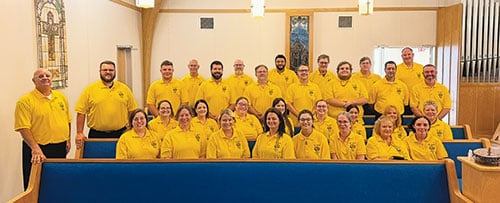
The first rehearsal was in July with eleven people. For the first concert in August, we had nearly 40 players. The audience was large, and the Christmas concert was even larger. The West Newton Community Band was born. (Apparently, I wasn’t the only one looking for that fifth level.) Our mascot is the hornet – a tribute to West Newton High School. All that remains of that school is a run-down gym, where we will always give our concerts. Even our colors are black and gold, just like the Hornets.
I wasn’t surprised to find musicians eager for a new project. I was surprised to rediscover how it felt to think about leading and inspiring an ensemble. I wondered if this old dog could remember his tricks.
Every level of ensemble has different challenges to meet. In elementary school, you introduce. In middle school, you develop. In high school, you refine. In college, you specialize. Leading a community band is partly a restoration project. You restore embouchures, confidence, and identity. These goals change how you teach.
Adults are not students, and that is a gift. Band members arrive tired after taking care of their families and working all day. Some haven’t touched their instruments since the Nixon Administration. Range is limited, and endurance is fragile. Fingers cooperate less than they once did. Still, these players show up smiling.
It takes courage to see a video, call your parents to find your old horn, and show up somewhere not knowing what to expect. It is an opportunity to do something you loved and never thought you would do again. Some doubts come up. “Whoa! Can I still do this?” For me and everyone who joined the group, it took guts, faith, hope, and need just to walk in the door.
Sometimes a player will forget a key change, a random squeak will jump off the page, or someone will realize they are playing the wrong tune. We all laugh. They are not there for a grade. They are not there for a trophy or because it fits their schedule. They show up because, at some point, playing an instrument meant something. I’m honored by that.
Success Comes First
Early on, I made a decision that went against every competitive instinct I developed over 35 years of teaching: program easier literature that would sound good quickly. I made the choice because success restores identity. When someone who hasn’t played in 20 years leaves rehearsal thinking, “That didn’t sound half bad,” they practice and keep coming back. They believe they can still do this.
You cannot start with the heavy lifting when embouchures are rebuilding and stamina is returning. You build the floor before you raise the ceiling. The quicker people experience an early victory, the quicker they are ready for greater challenges.
We began with easier pieces and gradually added more demanding works. Growth happened not because I pushed it, but because they wanted it. That motivation was powerful.
The Rehearsal Is A Performance
In schools, rehearsals build toward performance, for a community band rehearsals are the experience.
• The laughter after a missed entrance.
• The comment, “Uh oh – too many black notes right now.”
• The collective groan at a high brass passage.
• The applause when a section finally locks in.
Those moments matter as much as the concert. I used to measure success in ratings, precision, and execution. Now I notice:
• Did they come back?
• Did they bring a friend?
• Did they stay afterward talking?
If the answer is yes, we’re building something meaningful.
The Director Changes, Too
Starting a community band forces you to confront your ego. For decades, I programmed ambitious literature and pushed for growth on a schedule.
Now I ask what will make this experience meaningful. That might involve cutting a repeat to preserve endurance or ending rehearsal early because lips are spent. Sometimes we choose music that is joyful over music that is impressive. The concerts have been just as powerful with large audiences and growing momentum. People don’t need perfection; they need authenticity.
After 35 years, I thought I knew how to run a rehearsal, but this is different.
I am learning in real time how to pace, balance challenge with joy, and rebuild musicians who were once strong and are brave enough to start over.
I am also learning about myself. I don’t miss the daily grind or the administrative noise with a school program. What I did miss was the sound of a group breathing together before a downbeat. This band gave that back to me.
The Story Continues
In less than a year, The West Newton Community Band has progressed from eleven players to three community performances to playing the National Anthem at PNC Park for the Pirates in June.
This band and its members are an ongoing story. We don’t know exactly where we’re going, and that’s part of the fun. Every rehearsal, every concert, every laugh, after every small victory is a new chapter. In the end, we are not just rebuilding skills. We are rebuilding pieces of ourselves.