When the pandemic forced ensemble directors to rethink traditional rehearsals, long-held assumptions about ensemble instruction were suddenly open for reconsideration. During that time, I asked returning students a simple question: If conventional rehearsals weren’t possible, what musical experiences would you most want to explore? One answer emerged repeatedly: improvisation.
At the time, my ensembles were already performing works by a wide range of composers, including pieces with improvisatory elements. While these moments were technically available to all students, participation typically came from just a few. For many musicians, the expectation to perform confidently and consistently in front of peers discourages creative risk-taking. Even modest tasks – like ornamenting a melodic line – can feel intimidating. As a result, students often disengage instead of exploring their own musical ideas through improvisation.
Historically, this discomfort would have been unusual. For centuries, improvisation was an expected skill for trained musicians. Bach, Mozart, Beethoven, and Liszt were all celebrated improvisers, and ornamentation, cadenzas, and figured bass realization were central to musicianship. Over time, Western art music became increasingly tied to the printed score, and improvisation gradually receded from formal training. Today, classical performance culture often prioritizes accuracy and consistency over spontaneous musical decision-making.
In the United States, structured improvisation instruction is most commonly found in jazz and Black American Music programs. Because many concert band and orchestra students do not participate in these ensembles, the large ensemble may be the only place they will encounter improvisation. This places large ensemble directors in a uniquely influential position.
The pandemic revealed that large ensembles are far more flexible than previously assumed. Directors experimented with new rehearsal formats and approaches to music making, uncovering possibilities beyond traditional models. As institutions returned to familiar structures, much of this experimentation faded. While understandable, this return also represents a missed opportunity. Precision and creativity are not opposing values – both can coexist within large ensemble.
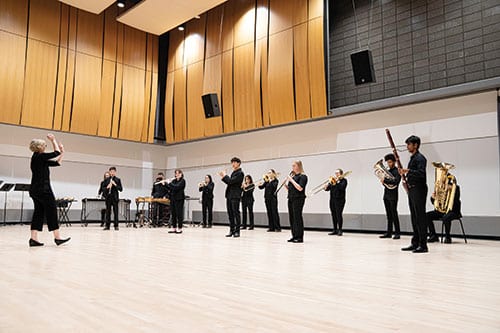
Why Improvisation?
Many students express interest in improvisation, yet few receive formal, systematic instruction. In rehearsal environments shaped by performance demands and limited time, creative exploration receives less attention than technical preparation and performance deadlines. As a result, students may develop strong interpretive skills while remaining uncomfortable making musical decisions in real time. Improvisation addresses the imbalance by engaging students more fully in music making in the moment. Combining improvisation with classical repertoire offers clear cognitive, musical, and artistic benefits for both performers and listeners that go well beyond creativity. These benefits include the following areas.
Listening and Ensemble Awareness
Improvisation requires active listening and immediate response to musical context. Students become more attuned to balance, timing, texture, and gesture – skills that directly enhance ensemble performance in notated repertoire.
Confidence and Expressive Development
Structured improvisation allows students to develop distinct musical voices within a collective setting. Over time, this fosters confidence, expressive depth, and a stronger sense of musical ownership.
Applied Theory and Ear Training
Through improvisation, students internalize scales, harmonic progressions, rhythmic patterns, and formal structures. These concepts become practical tools rather than abstract ideas, strengthening theoretical understanding and aural skills.
Musical Fluency and Resilience
Improvisation encourages students to continue playing despite uncertainty or mistakes. This builds musical fluency and resilience – habits that often translate to improved sightreading and deeper musical literacy.
Challenging the Composer-Genius Myth
Encouraging students to generate musical ideas helps dismantle the romanticized notion of the solitary composer-genius – a construct that has historically reinforced exclusion within Western classical music. When students create and perform their own ideas, they begin to recognize their voices as musically valid and worthy of attention.
Broader Worldview and Career Preparation
Many musical traditions rely on oral transmission and improvisation. Exposure to these practices broadens students’ understanding of global musicianship. As professional opportunities increasingly value versatility and adaptability, improvisational skills become an important component of career preparation.
Audience Engagement
Improvisation also enhances the concert for listeners. When audiences understand that elements of a performance are created spontaneously, engagement and attention increase. These performances often feel more immediate and connected, strengthening the relationship between performers and listeners.
Strategies for Implementation
Incorporating improvisation into large ensembles presents real challenges. Student comfort levels vary, rehearsal time is limited, and outcomes are less predictable than in fully notated performance. These challenges, however, are pedagogical rather than practical and can be addressed through clear structure, intentional sequencing, and thoughtful repertoire choices. Improvisation can be integrated into large ensembles in ways that are manageable, flexible, and appropriate across teaching contexts. The key is to match the level of structure to the experience of the students and director, and to treat improvisation as a developmental process rather than a single skill to master.
Model Willingness Rather Than Expertise
Directors do not need to be accomplished improvisers to teach improvisation effectively. What matters most is a willingness to explore alongside students. Modeling curiosity, asking musical questions aloud, and acknowledging uncertainty fosters experimentation. If improvisation is unfamiliar for you, be willing to embrace the awkward. Learning alongside students strengthens the idea that musicianship is a lifelong process and often strengthens connection and trust within the ensemble.
Provide Clear Language and Expectations
Students benefit from specific prompts rather than open-ended instructions. Describing desired character, texture, density, or contour gives students a clearer entry point. As confidence grows, prompts can gradually become less prescriptive.
Begin Early and Build Sequentially
Introduce improvisation at younger ages through simple, low-risk activities so it becomes a normal part of music making rather than a source of anxiety. A sequential approach that gradually increases complexity ensures that students arrive in advanced large ensembles prepared for more in-depth and confident improvisational work.
Begin with Short, Purposeful Activities
Improvisation does not need to occupy large portions of rehearsal time to be effective. Brief activities at the beginning or end of rehearsals can emphasize listening, creativity, and engagement. Helping students recognize that they already improvise daily – through speech, movement, and decision making – can also lower barriers and build confidence.
Varied Approaches
Free improvisation, texture-based exploration, conducted improvisation, graphic scores, and systems such as Soundpainting offer structure while encouraging creativity. Allowing students to design or lead improvisatory cues builds confidence and ownership.
Select Repertoire Strategically
Choosing repertoire that incorporates aleatoric or guided improvisation allows students to engage creatively within a familiar framework. Less experienced ensembles benefit from works with limited choices and clearly defined roles, while advanced ensembles can handle greater individual and sectional responsibility.
Scaffolding Instruction
Improvisation exists on a spectrum, and the amount of structure provided should align with students’ experience, confidence, and listening skills. Thoughtful sequencing allows students to build comfort gradually while strengthening musical behaviors that directly support ensemble performance. Rather than moving quickly toward open-ended freedom, many ensembles benefit from extended time in highly structured and moderately structured environments, where success is clear and risk feels manageable.
Highly Structured Approaches
These are best suited for younger or less experienced ensembles, or for groups new to improvisation. Select activities that limit musical variables such as pitch, rhythm, or duration, allowing students to focus on listening, participation, and sound production without the pressure of “making something up” all at once. The approaches emphasize that improvisation is about engagement and responsiveness, not complexity. Directors should remind players that there are no wrong notes and that the primary goals are comfort, curiosity, and collective awareness. Activities build foundational listening skills and normalize creative participation, making improvisation feel accessible rather than intimidating.
Examples include:
• Improvise non-musically: Students learn to be in the moment through creating literal dialogues. Because they are fluent in language, start there. It can be as simple as the director asking a question and a student responding. This can move into movement and gesture as well. One person gestures or moves and another responds. These activities illustrate that improvisation already exists in daily life and lowers the psychological barrier to musical improvisation.
• Call-and-response: The director plays, sings, or claps a short pattern using limited pitches or simple rhythms. Students echo the pattern, gradually shifting from imitation to creating their own responses.
• Single-note rhythmic improvisation: Students improvise rhythms on one pitch using quarter and eighth notes. The focus remains on steady pulse, clear entrances, and ensemble alignment rather than rhythmic complexity.
• Sound exploration: Students sustain long tones while experimenting with dynamics, articulation, and tone color. Listening for balance, blend, and collective shape becomes the primary objective.
• Analogous exploration: Students respond to descriptive prompts such as “make a sound that is floating, heavy, sneaky, or silly, for example,” encouraging expressive intent without concern for style, specific notes, or rhythms.
Moderately Structured Approaches
This technique is appropriate for ensembles with some improvisation experience and growing musical independence. These approaches introduce more musical responsibility but with clear boundaries. The activities often connect directly to repertoire, theory, or ensemble skills, revealing improvisation as an extension of existing musicianship rather than a separate discipline. At this level, students begin making meaningful musical decisions while still feeling supported.
Examples include:
• Scale-based improvisation: Students improvise short phrases using a specific scale or mode drawn from current repertoire, increasing tonal awareness and pitch hierarchy.
• Student-to-student call-and-response: Students generate short phrases that others imitate or respond to, shifting creative responsibility away from the director and encouraging peer interaction.
• Ornamentation: Students add embellishments to repeated motives or melodies, beginning with small changes (grace notes, trills) and gradually increasing rhythmic and melodic variation.
• Texture-based improvisation: Assigning roles such as sustained tones, ostinatos, or short motives allows students to contribute creatively without carrying full harmonic responsibility. Removing the need for harmonic coherence can often free students to be more expressive.
• Conducted improvisation or Soundpainting: The director shapes texture, density, articulation, and form in real time using visual cues. Beginning without harmonic constraints and adding them gradually helps students remain focused on listening and responsiveness.
• Aleatoric cells: Students independently repeat or vary short, notated fragments, listening for balance, density, shape, and musical progression.
Open Approaches:
This is most effective with experienced ensembles that demonstrate strong listening, trust, and musical awareness. These approaches provide the greatest creative freedom and require students to take significant ownership of musical outcomes. These formats work best when students already possess the listening skills, confidence, and ensemble awareness developed through more structured experiences. Open approaches reinforce independence, collaboration, and musical agency while deepening students’ understanding of form, narrative, and ensemble communication.
Examples include:
• Harmonic frameworks: Students improvise over chord progressions or drones connected to the repertoire, historical period, or style being studied.
• Guided solo moments: Brief, optional solo opportunities within a fixed harmonic or rhythmic framework allow students to take creative risks while maintaining ensemble cohesion.
• Architectural approaches: Students collaboratively design the structure of an improvised piece – deciding on form, pacing, and roles – then perform within those agreed parameters to “tell the story.”
• Storytelling: The director provides a concept or idea, and student groups improvise together to communicate that concept with a clear beginning, middle, and end.
• Student-led improvisation: Students design or lead short improvisatory sections, transitions, or soundscapes within rehearsals or performances.
Conclusion
Improvisation is not an optional enhancement to large ensemble instruction but a powerful tool for developing musicianship, engagement, and adaptability. When introduced thoughtfully and scaled to student experience, it strengthens listening, confidence, and musical understanding without compromising ensemble discipline. By balancing precision with creative exploration, large ensembles can honor tradition while equipping students with the skills they need to thrive in an increasingly diverse and dynamic musical world.