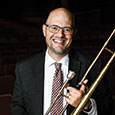
Since 2013, the Music Educator Award, sponsored by the Recording Academy and the GRAMMY Museum, has shined a light on some of the most innovative and inspiring directors around the country. Four winners talked with us about the keys of their successful programs, the surprise of receiving the award, and the essential contributions of colleagues, mentors, and students.
Jennifer Jimenez
2026 Winner
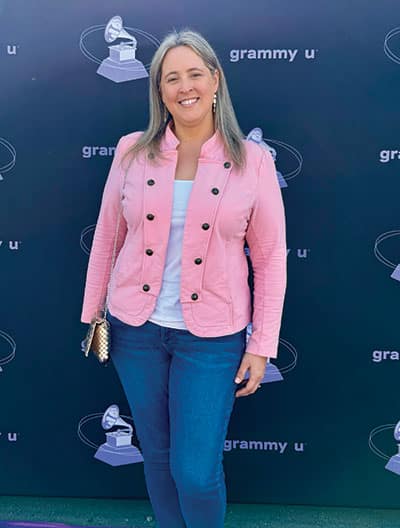
Jennifer Jimenez is the 2026 recipient of the Grammy Music Educator Award and the winner of the Kennedy Center Sondheim Inspirational Teaching Award. She is in her 19th year as Director of Bands and Elective Department Chair at South Miami Senior High. She came to Florida as a student at the University of Miami, where she was later inducted into the Band Hall of Fame. She is dedicated to promoting artistic excellence, community building, and music education advocacy. Jimenez earned the Florida International University’s Graduate Research Award for her work focusing on underrepresentation in music education. She is principal percussionist for the Miami Symphony Orchestra.
How did you find out that you were a Grammy recipient?
I received a call from the Grammy folks and thought it was another stage of my interview. There are a lot of stages. So, I wasn’t expecting a call other than a further, further interview. Instead it was one of the executives at the Recording Academy telling me that I had won. I was at my desk in December, and it was reindeer vs. elves day at work. I was in full reindeer antlers for Christmas, and I just remember sitting at my desk and crying. Luckily, I had the door shut because I had told students I had an interview. After I found out, I couldn’t tell a single person for a long time, which was tough.
What past experiences and former students flashed through your brain when you found out about the award?
As a parent, the first thing I thought about was that district solo ensemble was on the same weekend. I have two children who are musicians, and it was our daughter’s first solo. As a teacher, my first thought was “Why choose me?” There are so many incredible teachers. It’s just a humbling experience. I remember saying that to somebody, and they said, “Why not you?” It was very overwhelming. Imposter syndrome is real in our profession.
What makes your classroom special?
I talk a lot about how band is the family you choose. You don’t get to choose your circumstances or family, but in band or the performing arts, you choose a family. You can choose to show up, do the work, and be there for each other. You may not like everybody in band, just like a real family, but we are always respectful and treat everybody with dignity and respect. Everyone deserves that.
Because we built a culture of belonging, I do not do chair auditions. We have a collaborative, opinion-based system. This eliminates some of the cutthroat competition that is prevalent in upper-level music programs. I grew up in that environment but avoid it in my teaching. We have a culture of responsibility and teamwork. We can be direct, honest, and caring in class. I can tell students almost anything, and they know it comes from a place of deep respect and belief in them and their abilities. The results speak for themselves. We get kids who can barely hold an instrument in high school, and they go on to play grade four and five pieces in under a year and a half sometimes.
Can you describe how your decision to skip seating auditions works in your groups?
We have an application process for student leaders that includes an interview. Students share their opinions on who they see in those leadership roles, whether as section leader, librarian, or drum major. We give them a blank slate and the name of every kid in the band. I want their feedback for each position.
We believe that you should have strong players in every part. We have all-state players, and sometimes those students are on third part. Sometimes the third part is the most important. Range considerations might affect the placement of a trumpet player. However, at the high school level, everyone should have a wide range of skills. Having no auditions has been a great thing without fighting. We work to get better collectively, and bragging rights are for sections, not for chairs. You have to make sure everybody works together to achieve the best sound. There are some programs out there with killer players, but they don’t play well together. Their top players are all about themselves. We prefer to work together and collaborate.
What are some things that you think took you too long to learn in your educational journey?
As a percussionist, the hardest part for me was developing that ability to refine wind sound. I took some lessons on horn and saxophone, but I wish I had developed stronger wind-playing skills so I could teach those instruments more effectively
After 25 years, you look back and wish you had today’s ears as a brand new teacher. I wish I was better at demonstrating jazz articulations on a wind instrument because I didn’t do that as a drum set player. I brought in some fabulous friends to help me and learned so much from them. The only thing I am not really good at now is bassoon. I have really small hands. I am fortunate that wonderful bassoonists in the Miami Symphony can come out and assist me.
What is a tip or two for a young educator trying to get a foothold in this field?
All new directors are going to fail at something. You need to accept some failure and know how to pick yourself up and just keep going. Sometimes when somebody has difficulties, they shut down. They think, “I trained for years, and I’m not good at this.” I’m pretty tenacious, and that is an important quality for a new director. More than 20 years later, I still don’t get it right all the time. You have to give yourself the grace to fail.
Don’t be afraid to bring people in your classroom. After winning this award, I realized I would be out of class right before evaluations. I asked college directors to sub for me, just as students had received their new MPA music for assessments and didn’t sound good yet. I needed them to accept the chaos, which they did. The lesson for new directors is to put ego aside. Everyone can learn from other people rehearsing your group.
What is a lesson you learned from a mentor that you still use today?
I have been fortunate to work with many wonderful mentors starting with a middle school band director who was also my percussion teacher. I also had great people around me in high school and at Interlochen. What I remember now as a teacher and conductor was one of my first rehearsals at the University of Miami. I was a freshman, far from home. I didn’t know a single person when I walked in the door. I played a really solid audition and made it into the wind ensemble with all of these graduate students and great players.
I will never forget the first rehearsal. We were playing La Fiesta Mexicana by H. Owen Reed. I had the chimes part and played the dynamic as marked. At one point. Gary Green was on the podium and looked at me. He gave me a face that I couldn’t interpret as a young musician. Did he give me the face because it was wrong or because my dynamic was off? I didn’t know what to do, so I tentatively raised my hand and asked “Is that the dynamic you wanted there?” He looked at me and said, “I trust you as a player to use your ears to fit it in appropriately.” I was 18 and that was a defining moment. When he trusted me to make the decision, that was a huge moment for me with all of those older people. I immediately felt more confident.
How has this experience changed your life?
It definitely brought a spotlight to Dade Schools, Miami, my students, and our school. It has been extremely positive, and people are taking interest in helping our program with things like instrument repairs. My goal is to get more instruments for the program so I can have more students. I have gotten more media training and feel more comfortable fitting in an environment I never thought would be welcoming. People genuinely want to hear what teachers have to say, and they don’t know what goes on in classrooms. It has been valuable to speak with mayors, members of Congress, and school board members.
I am glad that our community is getting the spotlight. Our parents work hard, and most are immigrants. Many students have jobs and work nights and weekends. The only practicing we can do happens at school. To see that community rally and support us makes me so grateful. The parents and community have been recognized for their many contributions to our success.
Who did you meet during the Grammy weekend?
Everyone was so gracious with their time and wanted to be nice to teachers. I met Adam Lambert, Kesha, Busta Rhymes and Gayle King from CBS. I even met Miss Mariah Carey, the queen herself. When people pointed out somebody famous, I had no problem introducing myself. I teach high school kids all day, and they have no filter. It reminds you to roll with the situation of meeting famous people. At the Grammy ceremony, I met Jeff Goldblum, Heidi Klum, Rita Wilson, and Samara Joy. There were so many wonderful people.
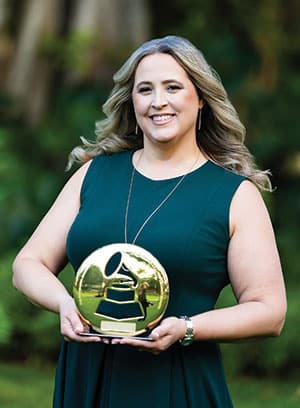
Stephen Cox
2022 Winner
Stephen Cox is the 2022 Grammy Educator Award Winner and a long-time Texas music teacher. He leads the Music Wonders program at the Willis Wonderland Foundation, bringing creativity and innovation to music education. His current work helps teachers integrate improvisation, composition, arranging, and songwriting into their classrooms. He previously spent over a decade as Director of Bands at Eastland High School, a small, rural district 126 miles west of Dallas. He established the Eastland Jazz Festival, an event that brings middle school, high school, and college jazz ensembles to Eastland’s downtown square. He is a graduate of Howard Payne University, Stephen, and his wife, Stephanie, have three children.
What do you remember about the day you won?
After receiving the news over the phone, I immediately called Stephanie, who was volunteering at an event with our children. We both had such a strong emotional response that everyone around us thought we were reacting to a death in the family. We knew immediately that it was a big deal and, while we couldn’t tell anyone about it, we assured everyone we were okay.
What do you think stood out to the committee as special about your program at Eastland?
Our program had a deep focus on our community. We did some projects that celebrated the musical history of Eastland. We worked with local businesses to decorate the square during Christmastime and held a jazz festival in conjunction with a Chamber of Commerce rib cook-off. In a small town, you can really integrate a program in a powerful way.
I think my application did a great job of showing what it’s like to work in a rural community. Thousands of teachers do the same thing and deserve the same recognition. It’s one of the frustrating things about the fact they can only give the award to one person.
The award narrative is focused on a single person, but programs aren’t built in a vacuum. I had an amazing team that did literally everything with me – Jett Lowrance, our middle school director, and Juan Hernandez, our percussion director. Every time I was interviewed I sang their praises but that part was never published because it didn’t fit the award narrative. I think I did good work, but it was teamwork and many, many directors are doing equally great work.
What are some things that took you a little too long to learn as a teacher?
The deepest thing for me is human psychology. When I started, I thought if students became good at making music, they would love it. I had it backward. If they love music, they are very likely to get good at it. We are trained to chase first divisions, and the job is much deeper and more personal than that. You can’t assume that just by having good instrumental pedagogy, winning a contest or having a band that sounds good, you are meeting long-term goals. That is the single most important thing that I’ve figured out in my career.
What advice do you have for a young educator trying to get a foothold in their career?
When I was in college, my supervising teacher told me some great advice. He said, “The biggest sin in music education is using the kids to make music when we should be using the music to make the kids.”
Pedagogy is hard. Developing your own ear is very, very hard. We get obsessed with those concepts, and it’s easy to miss that we need to be kind. We need to be available.
First-year teachers are often told, “Don’t smile until Christmas.” This is terrible advice. Yes, we are not friends with the students, but we should be perceived as friendly. They should know that you care about them and are on their side. That means showing up for them and treating them in a respectful way. If you combine that approach with great pedagogy, you will have all kinds of success.
Who were some of your mentors?
I grew up in a small rural school but I had the world’s greatest teachers. My music teachers advocated and supported me in all sorts of powerful ways, whether it was Andy Taylor spending his lunch break playing duets or Jody Reed convincing my parents to get me clarinet lessons.
It wasn’t just my music teachers either. Rhonda Howard, my english teacher taught me to advocate for myself, and Pam Jenkins, my science teacher, was a real life Mrs. Frizzle, dissecting and frying up a squid in class and showing up everything with enthusiasm and a science-themed wardrobe.
I hope I’m half the teacher any of them are.
How has winning this award changed your life?
It is a wild, flashy moment with photographers and media interviews. Then, the next week you are back at school. The experience made me ask questions about what I wanted out of my future and the impact I wanted to make. I mostly pursued opportunities that I would have pursued anyway because they made sense. I’m grateful for the ability to advocate for things I care about. This honor allows me to amplify the values I already had.
What was your experience on the night of the Grammys?
I had a pretty fantastic Grammy night experience, despite being absolutely terrified to talk to a celebrity. It is very strange to be in the middle of music industry royalty and I was afraid to talk to most people. If I did it again, I wouldn’t be afraid because when anyone found out we were teachers, they were so kind to us.
I was actually seated next to the CEO of Sony Music, Rob Stringer, and his partner Jules. From the moment they found out that we were teachers, they dedicated the rest of their evening to making sure we had an amazing time. This included inviting us to the Sony afterparty and introducing us to Doja Cat. That one photo opp made me so much cooler to my students.
From a personal standpoint, I really wanted to meet Jon Batiste. I think he is such an incredible force for musical good, and he was up for the most Grammys that year. By incredible luck, he won album of the year and went to the press room right as I was leaving and we met in the hallway. That was so fantastic and really capped off the event for me.
I’m really pleased that the Grammy Museum and Recording Academy take this award seriously. They could have had us outside in the parking lot and I would have been impressed, but they put us right there in the middle of everything. I think that says a lot about how they view the importance of music education.
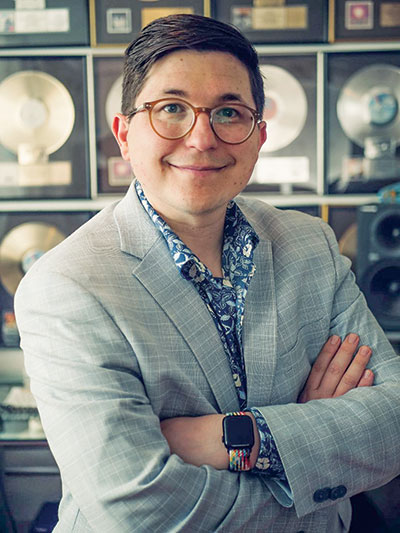
Annie Ray
2024 Winner
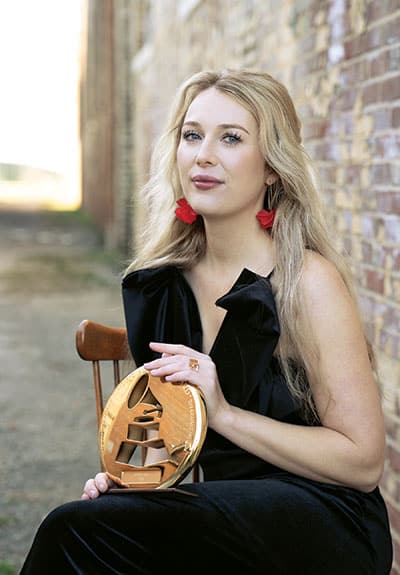
Annie Ray is Orchestra Director and Performing Arts Department Chair at Annandale High School in Northern Virginia, where her work centers on expanding access to high-quality music education and developing independent, confident musicians. Her teaching combines student-centered rehearsal practices, inclusive ensemble design, and community engagement, including Crescendo Orchestra for students with significant disabilities and Parent Orchestra, which brings families into the music-making process. Across her work, Ray focuses on creating multiple pathways for students to participate meaningfully in a traditional orchestral setting while giving them greater ownership of their learning. She received the 2024 GRAMMY Music Educator Award.
What was the moment like when you learned you had won?
I never expected to win. A colleague I very much admire nominated me. I had just had my second baby and wasn’t expecting the phone call. It came while I was driving, and both of my girls were actively losing it in the backseat. After I hung up, I couldn’t believe it had really happened. Life and teaching continued as normal. That was the most beautiful part of it. Our teaching and our students continue no matter what. Only my husband and my parents knew, and it was a special time to have the news just between us.
The teaching sample is a big part of the application process. What makes your classroom unique?
We have a diverse student population. Our school represents 66 countries, and 96% of our students are considered economically disadvantaged. Much of the teaching sample was trying to reflect our ability to connect no matter who you are. Some members of the media highlighted Crescendo Orchestra, our ensemble for students with significant disabilities, which is an important reflection of our commitment to access and belonging. That same philosophy extends across our entire orchestra program, where we focus on creating meaningful entry points for every student while building autonomy and ownership within a traditional orchestral setting.
I was born and raised in Texas and moved to Virginia when my husband won a job in Pershing’s Own. He is a euphonium player, and if a euphonium player wins a job, you go. My world was flipped upside down. I went from the teaching model I knew in Texas, seeing secondary students every day, to a very different system in Virginia. Since moving here, I have had the opportunity to teach elementary, middle, and high school, including beginning students I saw for just 30 minutes once a week. I am incredibly grateful for that range of experience because it has shaped both my perspective and my pedagogy. Teaching students across the full K–12 progression has helped me better understand where they are coming from, what they need at each stage, and how the choices we make at one level affect their musical development years later.
What aspect of teaching took you a while to learn?
Letting go and giving students autonomy. This is something I have worked on since moving to Virginia. I scaffold student-centered learning with the goal of gradually giving students more ownership of the music-making. My goal is to create musicians who no longer need me when they leave the classroom and can listen, problem-solve, and make musical decisions independently. The process can be messy, but that is part of the learning.
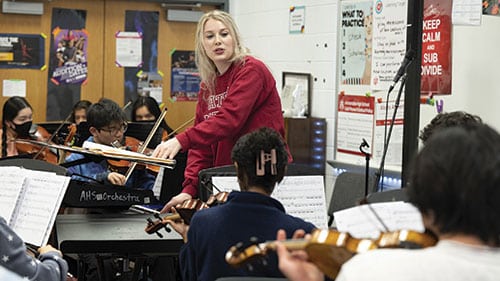
Is there something you do in every rehearsal?
We sightread every day, even my beginners. Rhythm is so important in the hierarchy of musical skills. Sightreading is the best indicator of what students know. It sets them up to be independent musicians. We start every class with a line I project on the board. Working on strong fundamentals helps students develop as independent musicians.
What advice do you give to younger educators finding their way in the profession?
Talk less and play more. One of the best pieces of advice came from one of my mentors, Dennis Langevin, who encouraged me to sit down and play with the students. When I started teaching in Texas, I took this advice. I would just rotate instruments, so I could hear what each section hears. A part in the music might be more challenging than I expected, and I might not have noticed on the podium. Cello is not my strongest instrument, and I might make mistakes and show students that it is okay to laugh when you fail at something. I think it is really beautiful to model that for students.
What else did you learn from a mentor that you still use today?
Dr. Elizabeth Chapell talks about “rote before note” (a Suzuki philosophy) and emphasizes the importance of making an excellent sound. A group is never going to sound mature unless you focus on tone. It helps to take away the music and teach by ear, entrusting kids to trust their ears. Dennis Langevin said “if you can hear it, you can play it.” Having students sing all the time or sizzle a rhythm is a huge core of my teaching.
Another idea that traveled with me to Virginia is our parent orchestra. My mentor in Texas, Brian Coatney started this idea. Now, I teach 250 caregivers how to play their children’s instruments annually with my co-founder, Dr. Michelle Keenan and co-director Austin Johnson-Stawarz, and 15 other amazing educators.
In what ways has receiving the award changed your life?
It has opened doors I never could have imagined, from speaking at the U.S. Department of Education to participating in projects with CBS Mornings and being featured in the Milken Center for Advancing the American Dream. I also feel incredibly lucky to travel the country conducting All-State orchestras, leading collegiate workshops, and giving keynotes. Those experiences let me learn from educators and students in very different communities, and I am grateful for the opportunity to represent and advocate for the work happening in music classrooms every day.
What celebrities did you meet as part of this experience?
I met so many people because my husband is my biggest cheerleader. At the Grammys, he was pretending to be my agent, and he got me introduced to people. I met Calvin Harris, Ed Sheeran, and Meryl Streep, and I was able to hang out with Oprah. I even posed for a picture with Taylor Swift. Billie Eilish was lovely, and then SZA crashed my interview, which you can see online. We ended up hitting it off. The coolest part is that they are just people. They are musicians just like us.
Mickey Smith Jr.
2020 Winner
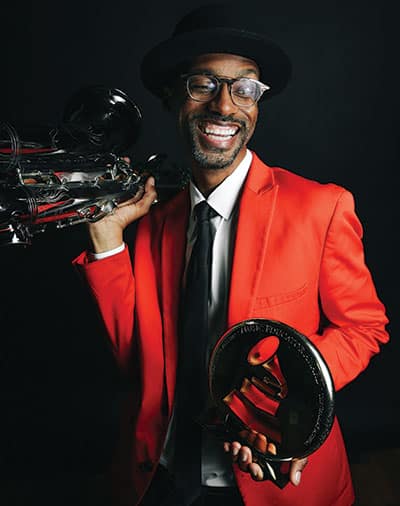
Mickey Smith Jr. is a Louisiana native who is now based in West Palm Beach, Florida. His life blends education, music, and motivational leadership. With two decades in education and eight Teacher-of-the-Year titles to his name, Smith understands what it takes to show up consistently and push others toward their potential as well. Married for over 23 years to his wife Eugenia and grounded in community, family, and faith, Mickey models what it looks like to live with purpose. His mission is simple: help educators and individuals ditch burnout, reclaim their passion, and live, lead, reach, and teach at full volume.
What were you doing when you found that you were chosen and what was your reaction?
I was working late as so many directors do, and I received a call. It was the announcement that I was the winner. I was filled with emotion primarily because I hadn’t planned to apply that year. Someone nominated me years ago. I didn’t think it would go anywhere, and it started a seven-year journey. I lost six years in a row. I never felt like a loser because every time I learned something more about who I was to the students. I realized that the experience was more than just teaching. It was an opportunity to inspire people, and it helped me sharpen my craft. The last year I lost, it brought a lot of tears to my wife and two children. One of them was in the band at that time, and when I saw how hurt she was, I decided it wasn’t worth it.
My cousin Lisa called me, and we talked for a while. She told me three words – keep on going. She didn’t realize that these were the words I told my students all the time when they want to give up. Lisa first told me I would win a Grammy when I was 12 years old. I decided to try again. She told me specifically to be authentically me. She told me to wear a hat that she bought me even though I didn’t like it at the time. I submitted my Grammy artifacts on June 20, not realizing that two days later, she would pass away unexpectedly.
I was in a very low place that year, and winning the Grammy was the last thing on my mind. When I got the call, I felt a flood of emotions, not necessarily because Lisa wasn’t there. She saw this well before anybody did. I wear the hat because I feel like everybody would have been better for meeting Lisa because she’s just like that person. So, even if you never met Lisa, when you see the hat, hopefully, you see Lisa. When I won the Grammy, I felt a sense of fulfillment and love.
What made your class and situation unique?
Out in Los Angeles for the Grammys, my wife and I watched a story come on CBS This Morning about my selection. I couldn’t help but think, “why did they pick me?” When I heard the testimonials by my students, their comments touched my heart. I knew they were being transparent and authentic.
To answer your question, my class is not just about music. It is equally important to show students that they matter. I’m not a big crier, but it got me. The Grammys and the Recording Academy selected Mickey Smith Jr., not just on his ability to teach, but on the ability to create a classroom that showed his students that they are loved, valued, and wanted. You can have all the pedagogy, but you need to have a heart, too. If we just hang our hat on our knowledge base, we’re no different than AI. The human element is essential.
What is a teaching tip that you could share with a director coming up in the profession?
One of my greatest mentors was Dr. Harry Wong, a classroom management guru who recently passed away. He contacted me after I won the Grammy, and I was shocked. He had been following my work in the classroom and asked where I got all of these amazing ideas. I took a big gulp and told him I stole them from him because I did! We laughed because that is one of his major pieces of advice. He encourages folks to steal good ideas instead of reinventing the wheel. Find individuals who are experience and start to glean from them. He suggests taking those elements and making them uniquely yours.
If I could give a second piece of advice, it would be to make sure you have your core four. You need an ensemble of individuals who help in your professional journey. I believe every music educator needs a cheerleader. It might be someone on campus who can encourage them because we do that for the kids so well. Often, we forget to put people in place who can support us in our careers.
In addition to a cheerleader, you also need a coach. Tom Brady had a coach. Michael Jordan had a coach. The coach serves as a mirror. They show what you can’t see for yourself. Third, everybody needs a mentor, someone in the profession who is doing what you hope to do at the level you aspire to someday. In any activity, we can only be what we can see. Mentors give you that blueprint and inspiration. Music has to have a muse; your mentor takes that role.
Finally, you need an advocate, someone who can speak for you in rooms where you aren’t able to be in yet. The song says, “I want to be in the room where it happens,” but most of the time, decisions are made before you ever enter the room. Having someone to advocate and speak for you is powerful. Depending on our progress in the game of teaching, we may not have the credibility, experience, or the weight to speak on something that someone else will.
What is something you learned even earlier from a mentor?
Dr. Quincy Hilliard is a prolific and amazing educator and composer. He’s always mentoring young educators, and I was blessed to have him in my life. He told me you can’t tune bad tone, musically or personally. You can have an expensive instrument, but if you don’t have a good embouchure, it doesn’t matter.
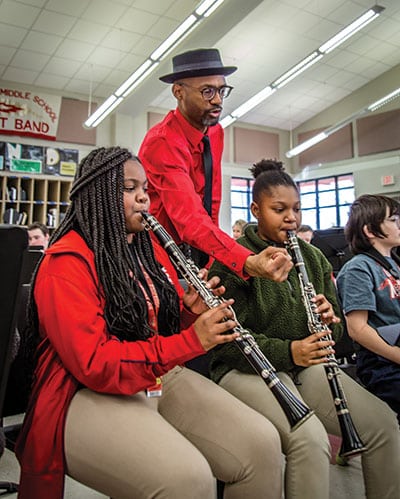
How has winning this award changed your life over the last several years?
I would be amazed at anybody whose life didn’t change under the circumstances. I have moved to an entirely different part of the country. It has made me visible in ways I never imagined. Most importantly, it has given me a valuable sense of awareness. Getting the Grammy challenged me to take a fresh look at every situation I’m in and has led to some amazing relationships. As a recovering introvert, it’s a great icebreaker and a great way to meet people that I wouldn’t have been capable of doing on my own.
Did you get a chance to meet any famous people in Los Angeles during the Grammy ceremony or during the year?
Before the Grammys that year, a fellow winner called and coached me. She knew I was deathly afraid of making these interactions. She said I would regret it forever if I didn’t talk to celebrities at the event. I met Jim Gaffigan, Dave Chappelle, Billy Ray Cyrus, Billie Eilish and her brother, and Lizzo.
I met Branford Marsalis, which meant a lot to me because I’m from Louisiana and played saxophone as a kid. I ran up to him, and he asked if he knew me. I said my name and that I was the Grammy music educator. He said, “I knew I knew you. We watched you on television on Thursday.” He then called another guy over and said, “This was the guy I saw on tv. I admire what you do.” We took a picture and had a great moment together. The biggest surprise was still to come.
The Grammys that year happened on the same day that Kobe Bryant passed away. The show was revamped because they wanted to honor him. I was sitting in my seat when they told me that I was in the wrong seat. My wife told me to move to the new seat. The commercial was ending in 30 seconds. The producer comes to me and says, “She’ll be there in 30 seconds. You just sit here.” All of a sudden Alicia Keys walks up. She acknowledges me, gives some praise, holds my hand on live TV, and tells me that we need you. It was just a beautiful moment.