With the year-long celebration of America’s 250th Anniversary, we are reminded that music has been woven into the fabric of our country from the start. George Washington’s army used drummers and fifers for an important communication role because battlefield commands could not be heard over the gunfire on the battlefield. The musicians often used young boys and men beyond fighting age to give such commands as march, turn, load, and fire. In camp, these musicians helped to regulate daily life and improve morale. At Valley Forge, Washington was serenaded on his birthday by these musicians playing in bitter cold weather.
America’s First Civilian Band
The Allentown Band of Allen-town, Pennsylvania is the oldest civilian concert band in the U.S. and continues to the present day with around 40 performances per year. Over its long history, the band performed for many notable events including for ten U.S. presidents. The Allentown Band’s first known concert was on July 4, 1828, although there is evidence of an earlier fife and drum corps dating back to 1822.
After the July 4th performance in 1828, the local newspaper wrote about the event a few days later.
“The Fourth of July was celebrated with great enthusiasm. At daybreak the bells of the town sounded, and 24 shots were fired from the cannon on Hickory Hill. The Allentown Music Band playing war music marched through the streets. A hickory pole was erected on the square, on which an American flag was placed.”
John Philip Sousa regularly recruited members of The Allentown Band to play in his ensemble. Many returned home with stories about Sousa’s performance practices and interpretations. Over time, The Allentown Band adopted many of these. Albertus L. Meyers, a cornet soloist, was the most influential of the Sousa alumni to return to the Allentown band, which he conducted for 51 years.
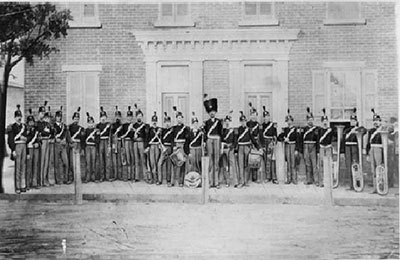
Earliest known photo of the band from 1872
John Philip Sousa
(1854 – 1932)
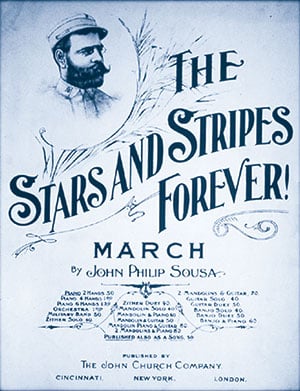
John Philip Sousa was a trailblazer as a composer and as a band director. He wrote 136 marches, 15 operettas, 70 songs, 11 waltzes, and 20 band fantasies. He also wrote seven books, of which two were novels. Some of his most famous marches are Stars and Stripes Forever, Semper Fidelis, The Washington Post, El Capitan, and The Thunderer.
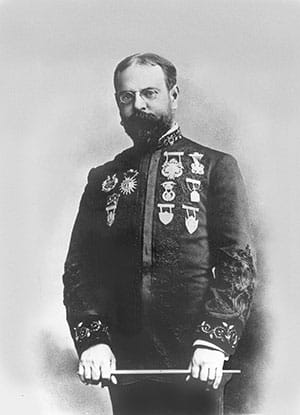
Sousa spent almost 20 years in military service over several stints. He became the leader of the Marine Band at age 26. It was there that he perfected his musical skills.
When Sousa left the military, he formed the Sousa Band, which played everywhere for huge crowds. He hired the best musicians and always programmed several featured soloists. The Sousa Band brought performances of fine music to smaller cities that did not have symphony orchestras. He was always eager to help struggling young composers, and his band probably played more new, unpublished American music than any other musical organization in the country at the time.
Sousa was part of two important July 4th celebrations. On the first centennial in 1876. Sousa was living in Philadelphia and working as a violinist, composer, and arranger. On July 4th that year, he played violin in an orchestra led by composer Jacques Offenbach. By then, he was receiving notice for his composing abilities.
For the 150th Anniversary in 1926, Sousa and his band premiered three works at a concert in Hershey, Pennsylvania, including Sesquicentennial Exposition March, The Pride of the Wolverines (dedicated to the people of Detroit), and The Gridiron Club. His Stars and Stripes Forever has remained a patriotic staple since it was first performed in 1896.
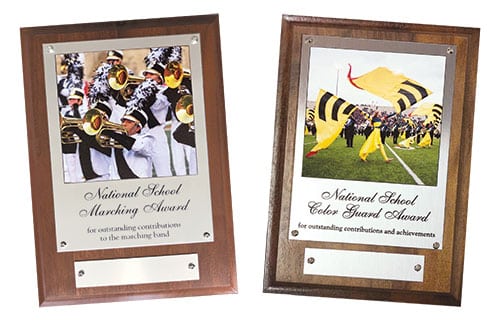
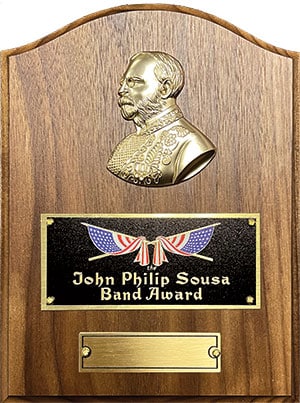
The Instrumentalist initiated the John Philip Sousa Band Award in 1954, on the 100th anniversary of his birth, with the enthusiastic approval of Sousa’s daughters, Helen and Priscilla to recognize superior musicianship and dedication in high school bands.
Patrick S. Gilmore
(1829-1892)
Father of the American Concert Band
Patrick Gilmore played a key role in the celebration of some important American milestones. He played for every president of his day, including Abraham Lincoln, and was the musical director for the official 1876 Centennial celebration in Philadelphia.
He was known for grandiose performances and enthusiastic promotion. At the 1864 inauguration of a Louisiana governor, he enlisted a brass band of over 500, a chorus of 6,000, a battery of artillery, 50 anvils, and the church bells of the city.
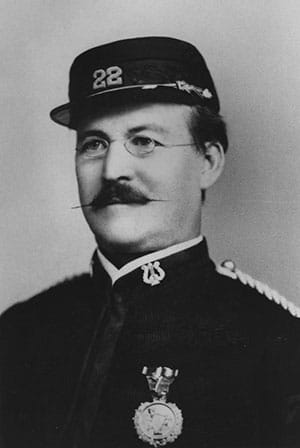
He conducted his band at the dedication of the Statue of Liberty in 1886. While the event was plagued with heavy weather and disorganization, Gilmore directed a concert of patriotic marches and French folk songs.
In 1891 he made some of the earliest commercial recordings at Thomas Edison’s laboratory in New Jersey. One of Gilmore’s most famous compositions is When Johnny Comes Marching Home. He was preparing for the 400th anniversary of Columbus’s arrival when he passed away on September 24, 1892.
The Patrick S. Gilmore Band Award was introduced in his honor in 1994.
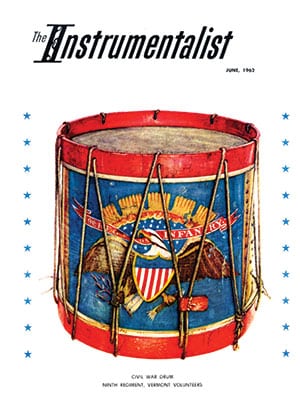
During the Civil War, bugles, drums, and fifes continued to be used for signals, orders, and to boost morale. In 1861, it was decreed that regiments should include brass bands. General Philip Sheridan once said that “music has done its share, and more than its share, in winning this war.” He would have his musicians stand behind the battle line and play patriotic music. Many popular patriotic songs were written during this period, and musicians from different parts of the country shared their musical traditions.
Duke Ellington
(1899-1974)
Composer, Pianist and Bandleader
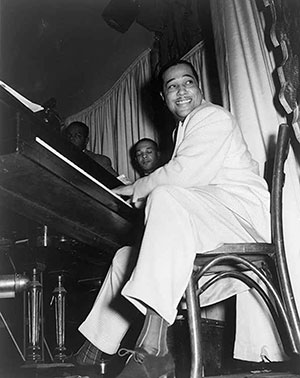
Duke Ellington was born in Washington, D.C. and became known throughout the world as a pianist, bandleader, and composer. Although he was called a jazz musician, he liked to call his work American Music.
In the 1920s, Ellington moved to New York City and started his own band. Later, the Duke Ellington Orchestra performed around the U.S. and on popular national radio broadcasts.
With the rise of rock music and the decline of big bands in the 1950s, many bandleaders struggled to keep their groups afloat. Even Duke Ellington’s band was forced to play some gigs at amusement parks and other subpar settings. Ellington began mounting a comeback with a memorable performance on July 4, 1959, at the Newport Jazz Festival. Highlights of the performance included Idiom ’59 and the theme from Anatomy of a Murder. He received the Presidential Medal of Freedom in 1969.
Louis Armstrong
(1901-1971)
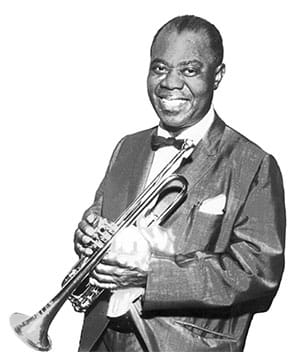
America’s goodwill ambassador, Daniel Louis Armstrong, was the epitome of jazz as a trumpeter, singer, and improviser. His imagination and phenomenal skill dazzled audiences worldwide and revolutionized jazz. He played in several jazz bands before forming his own with the encouragement of his wife, pianist Lillian Hardin.
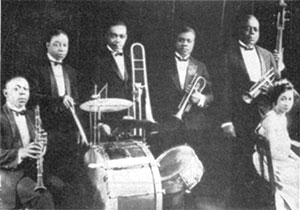
Above: King Oliver’s Creole Jazz Band, Chicago, 1923 (left to right: Johnny Dodds, clarinet; Warren “Baby” Dodds, drums; Honore Dutrey, trombone; Louis Armstrong, cornet; Joe “King” Oliver, cornet; Lillian Hardin Armstrong, piano).
He led a remarkable life from his early days in New Orleans to performing throughout Africa in 1960 as the leader of a U.S. State Department tour. While he represented his country overseas, Armstrong also spoke out periodically about civil rights injustice, including during the 1957 integration standoff at Central High School in Little Rock, Arkansas.
Ricky Riccardi, Director of Research Collections for the Louis Armstrong House Museum, has written about Armstrong’s 13-second opening cadenza to West End Blues on a 1928 recording in considered a definitive moment that transformed jazz from a collective entertainment style into a serious solo art form.
Louis Armstrong and the All-Stars were huge hits abroad, and his album, Ambassador Satch, captures some of the excitement of his 1955 tour of Europe with riots in virtually every country when the supply of seats gave out. Louis said that in West Berlin, people sneaked over from the East Zone, including some Russians.
“Hardly any of them could speak any English, but that didn’t bother them or us. The music did all the talking for both sides.” Louis Armstrong was indeed an American ambassador of jazz.
The Louis Armstrong Jazz Award was introduced in 1974 to honor outstanding student jazz musicians.
Marian Anderson
(1897-1933)
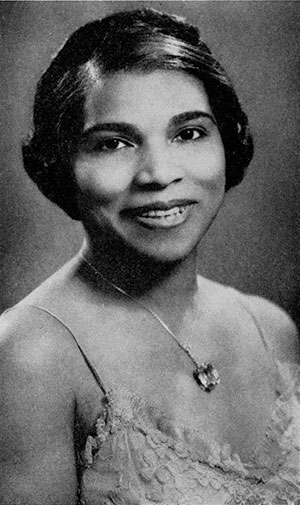
In April of 1939, renowned singer Marian Anderson was scheduled to perform in Wash-ington, D.C. After segregated venues refused to host the concert, First Lady Eleanor Roosevelt helped to move Anderson’s concert to the Lincoln Memorial. An integrated audience of 75,000 people gathered on the National Mall with millions more listening on a national radio broadcast.
As Secretary of the Interior Harold Ickes introduced Anderson, he declared that “genius draws no color lines.” This performance removed barriers for other musicians.
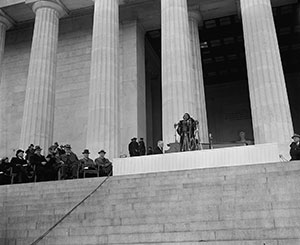
Concert at the Lincoln Memorial
Library of Congress Prints and Photographs Div.
Aaron Copland
(1900-1990)
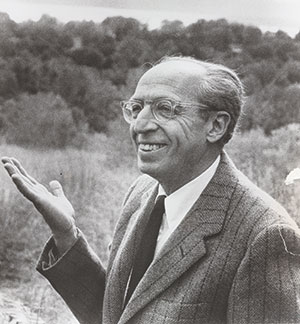
Aaron Copland wrote music with a distinctly American sound, using jazz, folk tunes, and blues in his works. He wrote a number of famous ballets and orchestral works, as well as chamber music, vocal works, opera, and later film scores. Toward the end of his life, Copland composed less and spent more time conducting and making recordings of his music. Copland was a major influence on American many composers and musicians, including Leonard Bernstein.
Aaron Copland on A Fanfare for the Common Man
“During the World War II years, I think it was an idea of Eugene Goossens, conductor of the Cincinnati Symphony, to start a concert each week with a fanfare connected with the war effort. I remember a fanfare written for that series called A Fanfare for the Fighting French, which I thought was an inspired title. I remember how I got the idea of writing A Fanfare for the Common Man (1943) – it was the common man, after all, who was doing all the dirty work in the war and in the army. He deserved a fanfare. That, too, was a lucky day because I think the title sticks in the mind. Later on, I used it as an integral part of my Third Symphony. (The Instrumentalist, November 1985)
Fred Waring
(1900-1984)
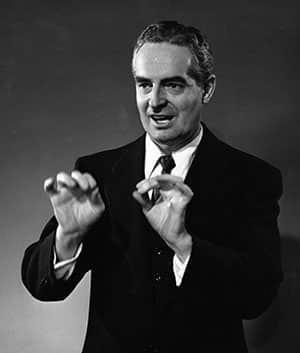
Fred Waring is credited with boosting the popularity of choral music and originating the concept of the show choir. Along with his musical organization – The Pennsylvanians – he initiated many firsts in show business. He was the first to feature vocalists with an orchestra, to combine an orchestra with a glee club, and the first to have a singing band.
The Pennsylvanians once performed its arrangement of Rhapsody in Blue with George Gershwin himself at the piano. Waring made a short film using an early sound-on-film process in the 1920s and had regular radio shows in the 1930s. In April 1949 The Fred Waring Television Show became the first weekly one-hour musical show on television and earned numerous awards for Best Musical Show. Through his 67-year career, Waring earned accolades from listeners and critics alike. To honor his work President Ronald Reagan presented Waring with the Congressional Gold Medal on December 15, 1983, which up to that time had been awarded to only five other entertainers in its 100-year history.
Woody Herman
(1913-1987)
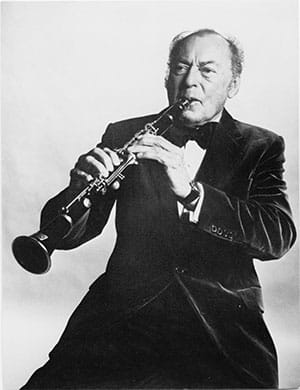
Woody Herman played clarinet and saxophone and led a series of bands from 1936 till his death in 1987. He began his career as a professional saxophone player at age 15. Perhaps remembering his youthful beginnings, Herman often took time to encourage young players throughout his career and was known for hiring up-and-coming young musicians, many of whom later became leading jazz performers.
Herman’s bands were known as Herds and performed under such names as Herman’s Herd, the Thundering Herd, and the Anglo-American Herd. His Second Herd began in 1947 and was known as The Four Brothers Band for its notable sax section with three tenors and a baritone.
Herman’s groups also gained a reputation for adapting their playing style over the years but always maintained the common thread of great musicianship. Some of Herman’s most well-known songs include: Woodchopper’s Ball, Four Brothers, Apple Honey, and his band’s theme song, Blue Flame.
The Woody Herman Jazz Award was introduced in his honor in 1989.
Quincy Jones
(1932-2024)
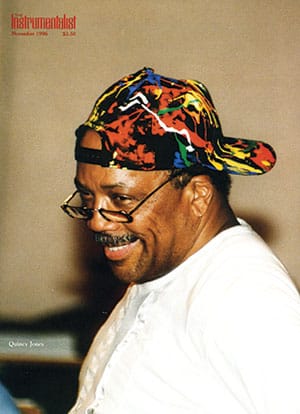
Quincy Jones, legendary composer, songwriter, arranger, and producer, has collaborated with the biggest names in music including Frank Sinatra, Count Basie, Ray Charles, Duke Ellington, and Michael Jackson. He received 80 Grammy nominations and won 28 Grammy Awards.
Jones accompanied Dizzy Gillespie on State Department tours of the Mideast and Africa in the 1950s and credits these travels for broadening his musical horizons. In a 2007 interview in The Instrumentalist he noted that “Good musicians have an interest in many types of music. We studied Ellington, Bill Evans, and everyone else.”
His musical portfolio expanded in the 1960s when he became vice president of Mercury Records in 1964. That same year, film director Sidney Lumet invited him to compose music for the film, The Pawnbroker. Jones ended up scoring nearly 40 motion picture scores, including The Color Purple, for which he received an Academy Award nomination. He became highly in-demand as an arranger and record producer.
The Quincy Jones Musicianship Award was initiated in 2011.
Leonard Bernstein
(1918-1990)
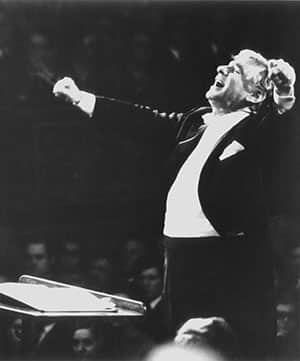
Leonard Bernstein immersed himself in music at Harvard University and the Curtis Institute of Music where he studied conducting with Fritz Reiner. In 1943 he was appointed assistant conductor of the New York Philharmonic and made his conducting debut with the orchestra when guest conductor Bruno Walter was stricken with the flu. This nationally broadcast performance brought him instant fame and led to many additional conducting appearances with other orchestras.
He was appointed music director of the New York Philharmonic in 1958 and held this post until 1969. He continued to conduct periodically with the orchestra throughout his life. Bernstein also gained great acclaim as a composer of such music as West Side Story, Candide, On the Town, and many concert works.
Bernstein was particularly proud of his work as an educator. One of his many projects was a series of 53 telecasts of Young People’s Concerts between 1958 and 1972. These concerts became a centerpiece of his educational mission. They were broadcast on CBS and covered the works of many great composers, some of the nuances of musical theory, and the meaning of music.
The Bernstein Musicianship Award was introduced in his honor in 2016.
John Williams
(Born 1932)
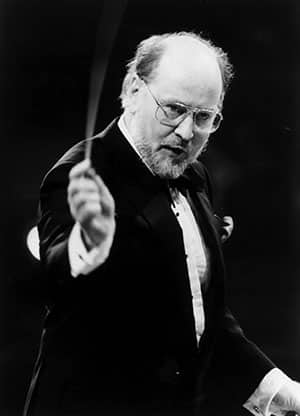
Photo: Richard Feldman. ©1985 WGBH Educational Foundation. All Rights Reserved.
Over a five-decade career, John Williams has captured the sounds of American life as music director and composer for more than 100 films from Close Encounters of the Third Kind to Saving Private Ryan. He has directed some of the most distinguished orchestras around the world. In our July 1984 issue, he shared his view of composing. “The best equipment you can have is a large arsenal of musical knowledge, combined with hopefully an intuition for writing that the best composers have always had…. My own commercial work is more eclectic than one would ideally want. Adaptability is a big part of working commercially. Trying to find the right idiom for each film and wed the music to the fabric and the ambiance of the particular story is so much of what we are trying to do.”