When a rehearsal or performance is truly alive with passion, energy, and excitement, everyone in the room can feel it. Everything seems spontaneous and flows with ease. All participants are active in the process and have a stake in the outcome. This is kinetic music-making at its finest. To develop this electric atmosphere, the conductor must thoroughly prepare in every aspect well before the first rehearsal takes place.
Roles of the Conductor
Conducting is a synthesis of many musical and psychological skills. At any given time, conductors must embody a variety of roles while knowing when to push, when to pivot, and when to lighten the mood. These roles include: artist-musician, educator, musicologist, music theorist, motivator, translator/interpreter, advocate, collaborator, and listener.
First, the conductor should work to stay inspired and inspiring. The best musicians are familiar with a wide range of music and can utilize that knowledge as part of their creative toolkit. If we only listen to band music, our point of reference is quite limited.
Without a thorough knowledge of music history and theory, a conductor cannot develop the informed perspective necessary for a beautiful interpretation of the music. It will also hamper moments in rehearsal when time is wasted deciphering the inversion of a chord or the tonal center of the music. That work is vital, and it must happen outside of rehearsal. These elements also help the conductor determine the composer’s vocabulary. Limited understanding by the conductor dulls the ability to translate the message effectively to the ensemble.
The conductor should measure the emotional temperature of the room. They have to know when to do intense work, when to focus on the bigger picture, how to hone the ensemble’s listening, and when to interject humor or take a step back. This is why the conductor must also be a listener. Even though the conductor bubble is real, we have to understand how the rehearsal is unfolding from the ensemble’s perspective.
Preparation
Meticulous preparation develops the potential energy in conductors. Only with extensive work outside of rehearsal with the score can this potential energy be converted into creative and effective gestures and movement. Thus, the conductor’s performance is the first rehearsal. While interactions with the ensemble in rehearsal may alter elements of the interpretation or overall plan, if the conductor has not prepared enough, their ears will not be open to what the ensemble is doing.
Another approach to score study is to think about a descending bird as it moves from high in the sky all the way down to the ground. Begin with the big picture elements including form, any programmatic aspects, and overall architecture, before descending to reveal the more intricate details, colors, and nuances of the music. Develop a snapshot of who the composer was when the piece was written. Do not limit the study to just the piece at hand. What pieces did the composer write directly before and after the work? What was going on in the composer’s life? Dig in to find each composer’s “DNA”. What rhythmic motives, color combinations, instructional phrases, etc. make this composer unique? This information allows the conductor to develop what H. Robert Reynolds called informed intuition, the idea that our gathered objective knowledge allows us to make justified subjective decisions.
The conductor should cultivate their third ear, the one inside the brain that allows us to audiate and imagine sound before we hear it. Gunther Schuller proposed that this should include detailed hearing in seven unique areas: harmony, rhythm/articulation, dynamics, pitch/intonation, color, balance, and line/continuity. If we can effectively develop all seven areas, imagine how much more detail we can employ in our rehearsals and interpretations.
Know all foreign musical terms in the score. They should never be translated as “watch the conductor.” Set the example for students, and expect them to know what all terms in their parts mean. This cannot all come from the podium. Word choices mean something. Music is like poetry in that way, and these terms add another layer to the interpretation.
There are many thoughts out there on score marking and how much, if anything, to write on the score. This is a personal choice, but the most effective method is the one that allows the conductor to retain information gleaned from score study without distracting from the printed page.
Interpretation
Everyone has a point of view. Interpretation is where score study and the conductor’s musical lens meet. We should work to feed our experience and develop our tastes. Listen widely. Read hungrily. Voraciously consume scores. Keep the mind open to new experiences.
When studying a new work, listening to multiple recordings is good and can provide musical fuel. However, latching on to one recording is no longer artistry. We should not be a musical photocopy. Similarly, practicing conducting to a recording is counterproductive. The recording will never change, so we are no longer reliant on our internal pulse or musical decisions.
In developing an interpretation, a conductor should consider form, architecture, tempo relationships, and even the diction of the music. Pablo Casals in the book Casals and the Art of Interpretation discussed how emphasis on just one note can alter the meaning of an entire phrase. He stressed looking for patterns that give a great piece of music its unity and coherence. If the passage is for a wind instrument, how might it be bowed? Consider singing the part during score study to find where the phrase glides and where it has gravity. The conductor should also work to bring singing into rehearsals as much as possible. Musicians sing, so getting students comfortable with it at an early age will reap many benefits later in their journey.
We must work to internalize not only the music, but our interpretation as well. This gives us a mental blueprint, an aural image that serves as a reference point throughout the rehearsal cycle. Without this aural image, rehearsals will be unfocused. In addition, this blueprint is the foundation for our gestures and movements. Without the creation of this potential energy through our preparation and decisions, kinetic music-making cannot happen.
Gesture and Movement
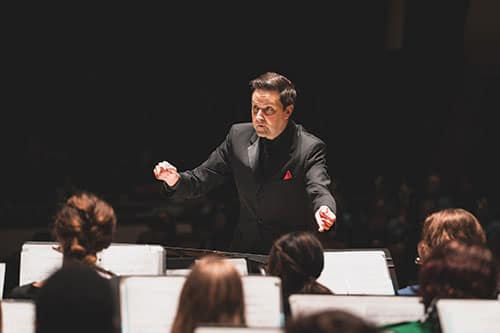
Conductors should start by understanding the difference between a gesture and a shape. While both involve movement, a gesture requires preparation, an ictus point, and a rebound. A simple shape requires none of these elements and usually reflects the journey between points of inflection. These inflection points are where conducting gestures take place. One way to create variety in gestures is to make effective use of the plane. The music should dictate whether you utilize the horizontal, vertical, or sagittal plane, and varying the plane depending on musical context allows for more creative possibilities to create the most specific gesture possible.
Another excellent way to build gestural vocabulary is through the ideas of Rudolf Laban, who codified how to move through space through three dichotomous categories: sustained vs. quick, direct vs. indirect, and light vs. heavy. When applied to conducting, it gives a foundation for eight basic gestures: float, glide, press, wring, flick, dab, slash, and punch. Many other gestures can branch out from these eight. One exercise I have employed with beginning conducting students is to conduct “Twinkle, Twinkle, Little Star” using only the eight basic Laban gestures – no patterns or time beating allowed. The variety of ideas that come from that exercise always impresses me.
Work to develop as much hand independence as possible. Elizabeth Green’s exercises are a great start. Do not think of the right hand as purely for time and the left hand as purely for expression. Beautiful, specific gestures can come from either hand. Know when to use each of the four hinges. While the wrist should be the most frequently used hinge for optimal efficiency of movement, there are always musical applications for the fingers, elbows, and even (on occasion) the shoulders as well.
Great facial expression amplifies and specifies any gesture a conductor makes. It should feel uniquely natural (i.e. do not try to imitate someone else’s face). This is another window for an ensemble to gain nonverbal understanding of the conductor’s interpretation. When combining gesture and facial expression, the result should be specific enough to successfully traverse the Seven Filters:
- The conductor’s aural image of the music
- The gesture itself
- The space between the conductor and the ensemble
- Each individual’s perception and thoughts about the gesture
- The individual players’ response through musical sound
- The audience/recipient receiving the sound of the ensemble
- The feedback of the audience/
recipient.
Only the clearest and most hyper-focused gestures can make it through that minefield. It is almost like a game of musical telephone.
Conductors should carefully consider how to move through space. Is everything the same size/force? How can we convey architecture and musical proportion through how we move? Use space in a way that reflects the scale of the music. We should regularly make videos of our conducting, even though it may be painful to watch. If we turn the sound off, can we still tell where we are in the music? My go-to for this is always the conducting of Carlos Kleiber. The specificity of his gestures was astounding and mesmerizing.
Rehearsal
While fastidious preparation fuels our creativity through gesture and movement, this potential energy can also be converted into a kinetic rehearsal technique. We must be collaborators. One way to do this is to be deliberate with our language. Use “we-us” instead of “I-you”. We are all working toward the same goal, so avoid making the relationship adversarial through poorly chosen pronouns. When things do not work, conductors are often just as culpable as the players, so take that ownership.
Make the players active and empowered participants in the music-making via guided listening. Do not facilitate an environment of trickle-down musicianship. Expect and enable the members of the ensemble to take responsibility for the process and the product.
Know when to use individual names vs. referring to an instrument name “Jane, that was a beautiful release” vs. “Trumpets, we need to tighten up our rhythmic precision in that bar”. Compliments to individuals go a long way, and people tend to take criticism better as a group rather than being singled out. These kinds of choices build trust. When we trust students, we build their confidence, and we build relationships. It is important that conductors see the students as people and vice versa.
Be on fire as a musician and as an educator. Students can see whether we are passionate about what we do or not. Our use of imagery/analogy when speaking helps the music come to life for the students. However, without knowing exactly what we want, our ability to pick the right adjective or create a perfect aural image is limited.
Final Thoughts
Work to be inspiring and inspired. Energy is contagious. Share discoveries with your students! Be prepared and organized. Come with a game plan and respect the students’ time. Record rehearsals often for both aural and visual reasons. Finally, try to use positive feedback to shape the narrative of the rehearsal. Ultimately, we foster kinetic music-making by creating an environment in which we would want to make music.