This interview was originally published in the October 1993 issue of The Instrumentalist.
Charles Vernon has played trombone and bass trombone in the Chicago Symphony Orchestra since 1986 and previously was a member of the Philadelphia Orchestra, the San Francisco Symphony, and the Baltimore Symphony. He attended Brevard College and Georgia State University. His teachers included Edward Kleinhammer, Arnold Jacobs, Bill Hill and Gail Wilson.
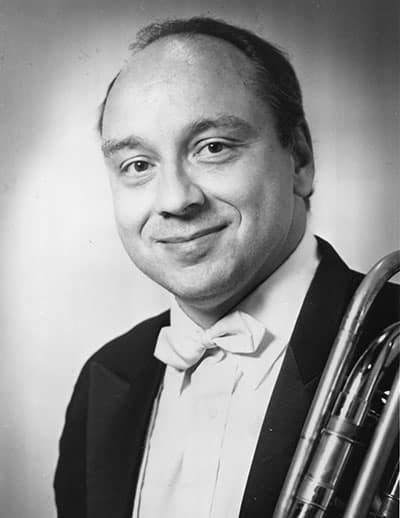
How do you achieve a great bass trombone sound?
Tone is the most important aspect of playing a brass instrument. What people will remember about a performance is the quality of the sound. My concept of tone began 25 years ago when Arnold Jacobs asked me to think about how the greatest trombone player in the world would sound on a low C before I played it. Before then, I never thought about what I would play – I simply played it. Gradually, I developed a concept of trombone sound by thinking about its most beautiful qualities. Adjectives can describe a sound, but what is more important is to have a mental image of the most beautiful sound and then to sing it through the trombone.
The most important thing is beauty. I could use many adjectives, but it should be a full, purple sound: thick, heavy, and fat. I have always thought of the bass trombone as leaning toward the tuba sound, and I have occasionally been criticized for playing the slide tuba; in some ways I do. On some contrabass trombone parts from The Ring, I want to sound as close to a tuba as possible. Perhaps I am a frustrated tuba player, because I love the sound of the tuba, especially in the middle-low register.
There are other times when it should sound like a baritone singing voice, with a round, easy sound, especially in the middle register, while the lower register should lean toward the tuba sound. Bass trombonists should try to enhance the tuba without competing with it. Having played with Arnold Jacobs, Gene Pokorny, and Floyd Cooley in the Chicago Symphony, I try to have my sound sit on top of theirs like a crown. The clarity or brightness of the octave adds to the body of the tuba sound, as in the beginning of Berlioz’s Romeo and Juliet.
Blending into the tuba and tenor trombone sounds can be touchy. A huge sound is inappropriate when the notes are the same as the tenors’. In turn, they should realize that parts in some registers are more appropriate when led by the tuba. The tenor trombone should hold back for a roundness of sound.
Under the pressures of a performance there is no time to think about the basic concepts of playing an instrument, but when you are practicing at home do you think in terms of singing or of colors?
In some practice sessions I will play only four or five notes for 40 minutes; it might be an exercise of dotted half notes followed by three or four beats of rest. I think about the greatest sound I can produce and how close I came to that sound. The thinking comes during the rests; the moment I pick up the trombone and blow air through it, the image in my mind is of singing, and I forget about the trombone. I never pay any attention to what I’m doing because I am completely immersed in the sound in my head. It is as though my brain is floating on the sound. Only during rests do I think about how close that sound was to the one in my head. During those rests I also breathe in air slowly to replenish the fuel. At the end of the three beats I just push a button in my head that says “OK, sound,” and I play.
You have tremendous flexibility and many different colors. How do you describe a dark sound or bright sound?
Many musicians think of dark as good and bright as bad, but to me a bright sound has many overtones and is intense. It is often the result of playing on a small horn. I think in terms of clear, resonant, and focused. For a dark sound, think of colors or adjectives like thick, buoyant, and round. The sound should be focused and centered because even if a sound is dark and weighty, it’s no good if it doesn’t have any center. It doesn’t have to be big, just compact, full, clear, resonant, beautiful, colorful, emotional sound. When singing comes out through the sound, this is the greatest thing in the world.
Do you use vowels to produce a particular tone quality?
Perhaps I did at one time, but now I think of singing the phrases. The human voice is what we should think about as we play with a big hunk of brass in our faces in order to make beautiful sounds come out of it. In addition to the concept of singing the phrases, I try to match the sound in every register, to play with the same tone quality. I start in the middle register and try to match the tone in several octaves up or down to the sound in the middle register.
How do you produce a centered sound?
I imagine a strong core sound, one that is like a pebble thrown into a pond. The ripples this creates are round, smooth, and move outward from a strong center. This is my mental picture. To develop this, mouthpiece buzzing is the most beneficial exercise. Buzzing gets the lips accustomed to resonating on a pitch, and after working on mouthpiece buzzing, there is more core to the sound. This is something people have always liked about my playing: even though I have a big sound, it still has a core. Many trombonists using the large equipment I play on have trouble focusing the sound.
When you pick up the instrument each day, what do you do first?
I usually buzz a little tune on the mouthpiece, or take a big breath to play something in first position, such as a Bb2. I don’t think about how my lips feel or about warming up. I just take a breath, and at the moment I blow, sing the sound. I just start to play. Don’t begin with crazy things. Play in the middle range where sounds come easily. Some people spend 30 or 40 minutes warming up on lip slurs and other exercises before they feel ready to play. That’s a luxury I’ve never had. With five minutes of mouthpiece buzzing and a few notes, I can play. This is mental. I have cut some rehearsals pretty close to the downbeat and played right off the bat. Because of this, I don’t look at warming up as a fixed ritual, just something easy and relaxed with the fundamentals of blowing.
Some teachers shy away from mouthpiece buzzing, and some students don’t understand its value. How should students approach this exercise?
I cannot tell you how many times I ask students to buzz the mouthpiece, and they cannot do it, either because they haven’t taken the time to learn this or studied with teachers who did not believe in it. I am convinced that deep down some teachers do not believe in mouthpiece buzzing because they never took the time to learn how to do it correctly.
Perhaps some teachers tried it years ago, didn’t like the sound, and concluded that buzzing was a bad thing.
That’s a possibility but a crazy conclusion. The brain sends out the signals for communication. In the case of singers, it is to the vocal chords, while brass players communicate through their lips. In both cases, the brain controls the muscle movements. This is a simple concept, but it is amazing how we all get away from this. You cannot buzz a mouthpiece without thinking about the tone or song. The most important thing about mouthpiece buzzing is that it channels the song from your head to your lips. This should be a four-lane superhighway rather than a dirt road with the bridges out.
Mouthpiece buzzing helps to center the sound. Many bass trombone players forget that within a huge sound there should be a massive middle or core. Mouthpiece buzzing does this, but I don’t know exactly how. Tone quality depends upon the right buzz, and this in turn depends on the strong mental image coming from your head.
I tell students to buzz at mf to f for an easy, resonant sound. At this volume, the air is moving in and out fairly rapidly. I think in terms of air speed for different volume levels. Air movement is the key to good playing. Arnold Jacobs describes playing a brass instrument as being song and wind. That is the simplest way to put it.
How would you describe the feeling of having a good supply of air? How would you convey to students what it feels like to have a good supply of air?
Just as Jake did with me, I ask students to make a breathing bag by taking a tube with the diameter of a nickel and taping a plastic bag on the end to form a bellows. At a tempo of quarter=60, students should fill the bag with air over four beats, then empty the bag over four beats by inhaling. Keep the beat steady and fill the bag over three beats, two beats, and then one beat. The goal is to get the same full breath in shorter amounts of time. Students should practice this two or three times in a row, but always with the air bag. Trying this without the bag will produce dizziness.
Have you had students who filled up with air, but if they held the breath for a moment, the sound seemed to explode through the instrument?
That is quite common, and I have experienced it myself. The easiest and the natural way to breathe is in one motion. However, there are many occasions during orchestral playing when I have four or five breaths to breathe. I will slowly breathe in, pause, and at the last minute I will breathe in some more. Brass players should be able to hold the air in and release it at any moment, but most have problems because they tighten up. Then, the air comes out like an explosion. When this happens, I ask a student to think about something else, such as playing tennis. Tennis players do not just stand there motionless as the ball approaches. They follow the ball and swing in one easy motion. When I breathe in and pause, then top the first breath off with a little more, this gives the breath a follow through. The muscles are moving the air just before I play.
How does an open throat enter into this concept?
Early on, I was told to keep my throat open by thinking about a hot potato in my mouth, but that concept just got in the way. It only taught me to suck air from the throat. Breathing that way gives me a dry mouth and doesn’t move much air. I try to stay clear of all of this and focus on bringing air in from my lips. This opens my throat up naturally.
What method do you use to play vibrato?
I use a lip slur for legato playing on the tenor trombone in the middle register, but from Bb4 to F5, or F#5, I usually use slide vibrato. When these sound the same, the audience cannot tell if it is lip or slide vibrato. The reason I use slide vibrato in the upper register is to avoid messing around with my lips. I start with a nice, centered sound and move the slide just a bit.
It is important to consider the style of the music when determining the speed of the slide or lips. The style of music affects the choice, too. For Mahler songs on trombone, I do whatever suits my emotion at the time. For the tenor trombone solo in Mahler’s 3rd, I use a wide slide vibrato, although some people get all bent out of shape because I use a slide vibrato. I don’t analyze the choice of a particular vibrato; I just try to sing through the instrument.
How important is physical conditioning in playing a brass instrument?
Ed Kleinhammer once told me that it takes an athlete to play the trombone. It was fortunate that while I was in high school, I was on the swimming team, and I have kept this up. Others use different sports, but swimming is the best exercise for me. While I swim, I try to imagine how I look in the water and what would be the most efficient way to put my hand in the water and pull my body through it. The same is true with trombone playing. I think about the greatest tone possible and try to match it. Swimming helps tremendously because bass trombone and tuba players move large amounts of air, just as swimmers do. Swimmers breathe in rapidly and in huge quantities, then blow it out in a controlled manner, while runners gasp whenever they want to. In any physical challenge, the motivation should be to work toward a goal. I try to channel my efforts in the water to become a better swimmer, just as I try to become a better player as I work with the trombone.
How do you control anxiety about performance?
There is always some anxiety until the music begins, but with certain difficult or exposed parts, I sometimes develop dry mouth. Only occasionally in the past did I become so wrapped up on warming up at the auditions that my nerves took over. This has happened to me about a half dozen times. I know I can play the job as well as anybody on this planet, but when I start playing and all of a sudden become concerned about what the committee is thinking, or who’s doing this or that, I get away from the music. Whenever you get away from the music, you start having extraneous thoughts about the dry mouth and some missed notes. The solution is to channel all thoughts into the music, and this will keep you going.
What are your suggestions for developing good slide technique?
Whether it is legato playing or rapid passages, the right arm should always react to the brain, which sends a signal from the head to the lips. With legato playing, the slide should move exactly as the second note is sung, but not in a jerked, abrupt fashion or a slow, slippery way. The slide has to move within a split second of the sound. Many people are uncoordinated in this area, which shows in slow, legato playing. The wrist should be slightly loose. The arms should never be stiff or rigid.
What makes legato playing so difficult?
There are two schools of thought about legato playing. Some players tongue every note, which is the easiest way to make them all sound the same. That’s why people do it. I am firmly entrenched in the other school and tongue legato notes only when necessary. All brass instruments are built on a harmonic series. As the trombone slide moves out, and the pitch moves up, you can slur the notes because they pop into the harmonic series. The trombone is the only instrument on which you have to match these two. For legato playing on the other instruments, the players just blow air and move the valves, letting the lips get the notes. The same thing is true with the trombone except for the slide movement. It is possible to play a middle D in three different places, but going from a middle C to D, most trombone players use the third position for C and the first position for D because that’s the way they were taught. This approach requires tonguing between the notes.
By playing C in third position and D in fourth, it becomes a lip slur. I think players should tongue as little as possible to increase lip flexibility. When you have flexible chops, the sound is smoother.
How should players expand their range?
Everyone uses different embouchures for different registers, but the goal should be for every note to sound easy. The first time I heard Bill Watrous play a high ballad I thought he played a beautiful high C. I found out later that it was a high F, but it sounded so easy and relaxed that I thought it was lower. In the extremely low register, I try to emulate great tuba playing or an organ. An organist doesn’t take in any air but just pushes the keys down, and this beautiful sound comes out. It always sounds easy. On low notes, I think about an easy, relaxed sound.
The middle low register is the easiest for me to play, so I think how easy playing in that register is as I move up an octave or two. This is a mental game that I also use with students, asking them to play a Bb4 while thinking of a Bb3. The secret is to breathe air in and to approach a note the same way, but at the last moment to make a little adjustment for a higher octave.
I’ve done my share of scales and arpeggios, usually playing slurs to build lip flexibility. I slur a lot in the lower and upper ranges. To build range, I take a simple song and play it in the bass clef as written, then play it down an octave. On the bass trombone, I may play it down two octaves, which takes me to the bottom of the piano range. On bass trombone, I have played the low Bb right before the end of the piano. In the second movement of the Zwilich bass trombone concerto, in front of thousands of people, I played a double-pedal Bb. I could do that because I spend so much time playing music down there. The music written for the bass trombone is seldom a challenge on the very low notes, so I frequently play down two octaves or work on tuba etudes and studies to develop the lower range. Another technique is to play tenor clef down an octave and sometimes two, which is mind boggling.
My approach on tenor trombone is different. I play down an octave in bass clef and then down an octave in tenor clef, sometimes down two octaves in tenor clef. Then I play it in tenor clef, which raises it up a fifth and makes the music much higher. There was a time when I struggled with that. Over a period of years, I have improved a lot. I will play something in tenor clef, then in alto clef, which raises it up another third above that. If that isn’t enough, I play it up an octave in bass clef, which is screamingly high.
For very high notes, I use more top lip and blow the air straight ahead or down a little. For very low notes, I shift to more top lip in the mouthpiece. I have worked that low register out to where I can perform comfortably down to a pedal D without shifting, but if I really want to nail that note or a Db, C, Cb, Bb, and maybe the A and fake an Ab, I put more top lip in the mouthpiece to sock these notes.
When playing in any register, I always think about the sound and the song. The listener should be completely fooled about what range you are playing. I recently played first part in an Andrew Lloyd Webber concert at Ravinia. The part had big ballad solos, one that started on a high G and went higher from there. The guy playing next to me said he was convinced that I was playing an E or D because it didn’t sound high. The best compliment is that it sounds easy. The key is to fool your mouth by thinking only about music and singing the songs. Let the body take care of the notes, and great things will come out. If you think about a difficult note, you will get into trouble.
Does playing in the outer ranges help to play the normal range?
Absolutely. This is one of the reasons I do it. If you play down in the sub-basement, playing up an octave is a piece of cake on the bass trombone. This is what makes the playing sound so easy.
To develop the extremes of range, play a simple melody in an easy register, then buzz it and play it, then buzz it again. Play it over and over in the middle register until you are comfortable about the sound and the air, then transpose it to tenor clef down one octave, or use the circle of keys. Always work for the sound and the musicality. Sometimes in clinics I amaze myself by playing unbelievably low or high because I am just thinking about the music, not the difficulty. Students should learn to experiment with ideas in this way. Take what a teacher says and try it, but if it doesn’t work, modify it to fit your style.
My high school director, Ed Benson, was a trumpet player. We played duets but he never gave formal instruction. When I studied with Bill Hill at Georgia State University, I wanted to play Blazhevich, Bitsch, and these French etudes, but he insisted on playing fundamentals. We played Arban and Rochut exclusively, and I thank him to this day for this training. I also listened to professional trombonists including Bill Watrous, Urbie Green, and of course, Tommy Dorsey. Their playing was beautiful, and no one ever told me that I couldn’t achieve the same excellence.