As the nation celebrates the 250th anniversary of the signing of the Declaration of Independence, musical programs will undoubtedly feature music of our heritage. Aaron Copland’s Lincoln Portrait should be among them.
A Vision
It took an enthusiastic champion of American composers to tell us repeatedly that there were artists who could create, envision and embody the essence of America. For many years Andre Kostelanitz conducted the New York Philharmonic in pops concerts and recordings featuring American music ranging from musical comedy and film scores to symphonic works. In addition, he commissioned works from American composers William Schuman, Paul Creston, Virgil Thompson, and others, to convey the spirit of the country through music. He also believed that specific individuals and certain aspects of the American scene be chosen as subjects for these works including locations such as the Frontier, the Hudson River, and New England, and individuals such as author Mark Twain, journalist Dorothy Thompson, and New York City Mayor Fiorello La Guardia. These places and people were to exemplify the courage, dignity, strength, simplicity, and humor so characteristic of the American spirit.
Background
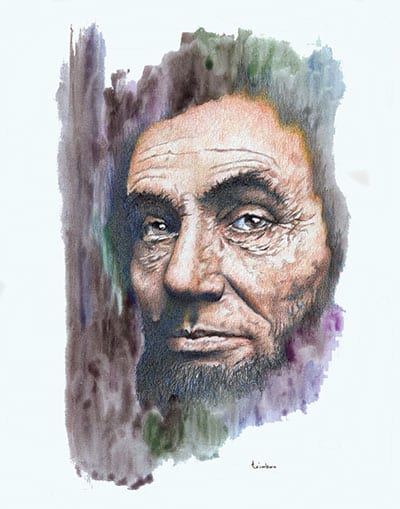
Aaron Copland was one of the commissioned composers and after first considering a work inspired by Walt Whitman, he ultimately chose Abraham Lincoln as the best subject for a musical portrait. He immediately realized, however, that no composer could possibly match through music so eminent a figure as Lincoln. As a result, he decided to call on Mr. Lincoln himself for assistance by using a narrator reading selections from his letters and speeches.
Since its premiere by the Cincinnati Orchestra in 1942 with radio actor William Adams as narrator, it has become a beloved piece in what is called the American style. In 1951, Walter Beeler, Ithaca concert band conductor and author of some 200 method books and transcriptions, arranged the piece for concert band. Since then, it has become a significant piece of repertoire not only for orchestra but for wind band as well.
Structure and Themes
Lincoln Portrait is neither program music nor a musical interpretation of a text, but rather a genuine portrait with a narrator as soloist. The composition is divided basically into three main parts. The first section is an evocative preamble suggesting Lincoln’s simplicity, gentle spirit, and humble personality. The middle section depicts the lively times in which he lived. The concluding part frames the immortal words of Lincoln himself.
Marked lento, the piece begins slowly and softly with a call or arch-like rising and descending motif that seems to come from nowhere, just as Lincoln did – mysteriously out of the wilderness. (In fact, a song heard during the 1860 presidential campaign was titled Old Abe Lincoln Came Out of the Wilderness). This original Copland material builds in volume and intensity to introduce the period 1840 folk song The Pesky Serpent, better known today as On Springfield’s Mountain (as recorded in 1949 by Burl Ives), treated freely rather than literally. With simple expression, this theme movingly expresses the feelings of majesty, strength, and sadness of heavy burden.
The lively middle section marked allegro begins suddenly, based on the perky tune Camptown Races and recreating the distinctive sound of a hoedown:
Gwine to run all night, gwine to run all day,
I’ll bet my money on a bobtailed nag,
somebody bet on the bay
This then becomes a more complex development treated as a round using On Springfield’s Mountain combined with Camptown Races as an obbligato.
As the tempo slows to poco largamente, the final section opens quietly as the narrator speaks the words of Lincoln, and we cannot escape history. The music neither interprets the words nor serves as background for them. Rather, there is an interplay of equals between the ensemble and speaker. There is an ongoing dialogue of words and music that frames them simply and impressively. At the conclusion, Copland provides music that towers with a majesty matching Lincoln’s vision – “government of the people, by the people, and for the people, shall not perish from the earth.”
Performance and Rehearsal Suggestions
The Beeler concert band transcription of Lincoln Portrait is 13 to 15 minutes in duration and is challenging rhythmically with exposed solo passages requiring a strong brass section. It is playable by the finest high school, university, professional, and military bands. The narration has been distributed worldwide, translated into eighteen languages. The luminaries who have delivered the text include Carl Sandburg, Marian Anderson, Eleanor Roosevelt, James Earl Jones, and William Warfield, who with Leonard Bernstein conducting the New York Philharmonic on their European U.S. tour during the 1976 American Bicentennial, spoke the words in flawless French, German, and Italian to tremendous ovations.
Preparation with younger students will benefit from careful rehearsal time and management including individual instruction and sectional practice due to the challenging rhythmical and solo demands. Of special note is the importance of securing a narrator who can pace delivery of the text within the musical framework. Listening to recordings can be helpful. Also, ample rehearsal is essential with the narrator and ensemble to ensure that the pacing of both music and recitation aspects align. Videos are also helpful for the conductor and narrator to get a sense of essential cueing and appropriate staging, setting, dress, and overall presentation.
Lincoln Portrait is in a class by itself. Copland himself thought of it simply as a portrait of Lincoln meant for a large audience and special occasion. His choice of Lincoln was based on the aura, time and history associated with him, and more importantly, his humanity and empathy.
This enduring and popular work provides an educational experience for students on several levels. Performances allow Copland’s brilliant music and the immortal words of Abraham Lincoln to continue echoing down the halls of time.
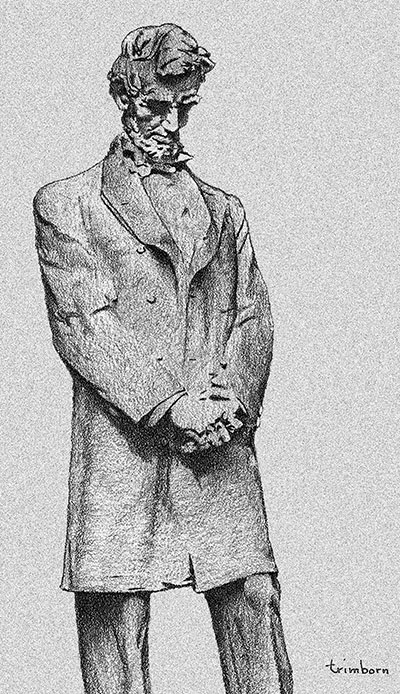
Article artwork by Thomas Trimborn
Tom Trimborn has conducted Lincoln Portrait numerous times most notably with Dr. William Warfield as narrator including a performance taped in California and telecast throughout Europe.