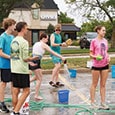
Music directors have their plates full getting their ensembles to perform the right notes, at the right time, with the right balance, blend and style. That’s what we’ve been trained for – sharing the love of music with students. However, we must also help students earn money to go on trips, pay entry fees, purchase music, clean the uniforms, provide meals, and more. It can be difficult to identify the right fundraiser for your program. Even the sweet taste of candy bars gets old. Selling trash bags means keeping an inventory, and cookie dough tends to sit in the freezer. A few years ago, I found a better option – car washes. Many community groups that hold car washes to raise money consider it a good day if they generate several hundred dollars. I would describe that as a wonderful team building and social experience for students, but not a successful fundraiser.

Several years ago, I read an article about a car wash fundraiser that raised up to $15,000. I was skeptical but kept the article. I found it a few years later and shared it with a colleague. We decided to try it and were astounded to earn over $8,000 the first year. Now, we’ve done it several times and made between $8,000 and $18,500 each time with only seven hours of work. Here’s how it happens.
Secure a good location (or two or three) for the event. You will want a big parking lot to pull cars through two at a time (side-by-side) from a washing station to a rinsing station and finally to a drying station in an orderly assembly line. The bigger the group, the more locations you will need.
Decide how to divide up students. I recommend having 16-24 person teams. With significantly more students, you can create shifts, but make sure their call times overlap. Our first shift comes in from 8:45 am to 12:45 pm, and the second shift covers 12:30 pm until 4:30 pm. We typically wash from 9:00 am until 4:00 pm and have 80-110 students divided between two locations. Some students enjoy working all day, and a few are unable to participate, but it all works out. For us, this means approximately 40+ students per location spread out over the day.
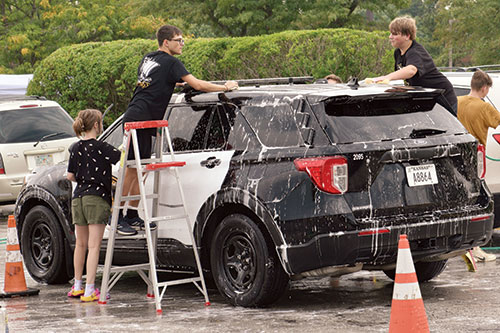
Pledges are essential to our success. Every student is expected to secure pledges prior to the big event. Our pledge sheets have five options: 2, 3, 5, 7 or 10 cents per car washed. Some people prefer to give a flat donation. We have found that we can wash more than 300 cars in seven hours between the two locations. We tell donors that there is a 300-car minimum, and the average pledge is 2 cents per car. If 100 students participate, with each getting twenty pledges, that adds up to $12,000. We also accept on-site donations, which adds around $1,000 at each location. Although not all students work to secure pledges, others have great success collecting pledges. Sometimes a grandparent or a close family friend will pledge five cents or more per car, so it all works out. Often, people round up on the pledges, so we tend to make a little extra. A typical automated car wash in our area costs between $10 and $25 per wash, so a $10-$20 pledge/donation for a hand wash is not out of the range that people are used to paying.
Those who make pledges receive a ticket to present the day of the wash. This method eliminates the awkwardness of asking for donations when customers arrive. Most people can just give the ticket to a student and on they go. (Those who don’t have a ticket can donate on the day of the event.) The ticket also provides the locations and times of the car wash. It is common to receive tips or a larger donation at the drying station because people appreciate the service after seeing our thorough work.
One key to our success is explaining the math with the students. I use the Mega Math spreadsheet (pdf) to illustrate how easy it is to make big money. We have a couple of short group meetings led by the drum majors – no more than about 10 minutes each.
Each drum major manages one site (remember the team-building aspect). They have a list of necessary items including washing sponges, drying towels, squeegees for windows, drying racks (for air drying towels to reuse), car soap, buckets, hoses, Y adapters, spray nozzles, 6-foot ladders, and signs that they ask students to bring. The booster club treasurer brings a cash box with fives and tens to make change.
We divide the car wash location into three areas. The plan describes where the queue will form to enter the wash area and designates the three key areas: washing, rinsing, and drying.
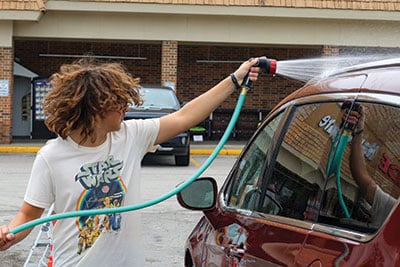
Washing: We need 6-8 people washing each car. Each person is responsible for a portion of the car. One student wets the car with a hose and a sprayer nozzle, then they start washing from top to bottom. It is easy to wash side to side, but we have found this approach is inefficient and leads to missing parts of the car. We make sure that not everyone is washing the hood or trunk, which are the easy parts. Someone is responsible for the hood driver’s side, front quarter panel, and wheel area. Another starts on the driver’s side doors from top to bottom. Someone else washes the back quarter and wheel area, and trunk on the driver’s side. There are three more students on the passenger side working on the same areas. The difference between a good car wash and a great car wash is paying attention to cleaning the tire rims, mirrors, and bottom of the doors. We try to achieve excellence in music and in car washes.
Rinsing: A student signals when to pull the car forward to the rinsing area, where another student rinses off the soap. At this point, someone examines the car for areas missed in the washing station and possibly provides a quick touch up.
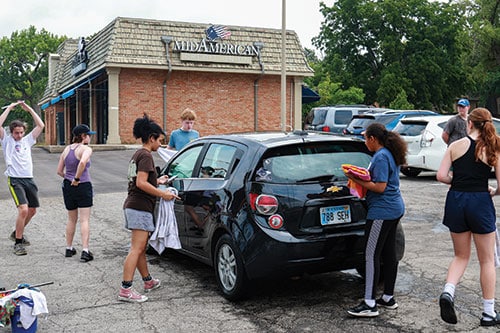
Drying: After rinsing the car, another student motions for the car to pull into the drying station for yet another team of students to towel-dry the car from top to bottom. Hand drying removes water spots and provides one last time to clean leftover grime. Squeegees work best for avoiding streaks on the windows. This area uses lots of towels, hence the need for towel racks or a rope strung between two trees or light poles, allowing the towels to dry for use later in the day.
We have students out near the street holding signs and directing traffic to the car wash. They must be energetic and active at all times. Sitting down or looking bored does not inspire confidence. Sometimes students bring instruments and play a few pep band tunes to get people’s attention.
Parents help in each of the washing, rinsing and drying areas. Because most students don’t have cars, they may not grasp the perfection an adult expects regarding getting in the cracks to make sure every inch of the car is clean. Sometimes in the rinsing area, we need to touch up the tires or a missed quarter panel. Designating a student as a Quality Control advocate is great leadership training and keeps everyone on their toes. Parents also bring water, a pop-up tent for shade, pizza, and other snacks.
Over the years we have washed RVs, motorcycles, fire trucks, and police cars, in addition to cars and trucks. We count fire trucks and RVs as three vehicles. We once had a gentleman tell us he was limited on time. He inquired how long it would take, and we told him five minutes. He responded that he would give us $50 if we could wash his truck in five minutes, but for every minute over he would subtract $10. From the time the water hit his windshield to the time it was dry was six minutes. Our system worked. We made $40 on his truck, and the kids were excited. That was great team building!
To increase our totals for the day, we encourage parents and students to get their car washed – even if they can’t afford to pay. Every band family tends to wash every car they own. Even students who might lack the money to wash their cars regularly bring them along. There is no pressure to donate. Every car washed is a bonus. The money that is donated at the event is not our primary focus; it is the pledge per car.
It is particularly satisfying that this fundraiser helps pay for band travel. To encourage students to hustle for pledges, they get to keep 70% of the profit from their pledge sheet, in their individual trip account. It is common for students to earn $300 to $600 for their individual account. The other 30% goes to the band fund for general expenses. By dividing the money 70/30 from a typical ($12,000) Mega Car Wash, the band still earns $4,000, which is still a good fundraising result, and students have added $8,000 to their accounts. which is a win for everybody. If we get rained out, we still collect on the 300-car minimum as stated on the car wash tickets – after all, this is a fundraiser. We have also begun taking donations using Venmo and other popular payment methods, which is a great help.
As an added incentive for students, if we raise $15,000 in pledges and donations, my color guard coach and I agree to dye our hair pink for a day of school. Other options teachers could use might be for a staff member to sleep on the school roof for a night or allow the top earning section to pie them in the face. These incentives provide a nice extra carrot for students.
All the forms that we use are included as pdfs. Change the name of the group, locations of the car washes and dates to make them yours. The kids have a blast, and you can make a lot of money for not a lot of work. Enjoy your clean car.
Car Wash Tickets pdf
Pledge Donation Sheet pdf
Car Wash Step by Step pdf