Even though I spent decades teaching high school and university students, my favorite age is middle schoolers. I enjoy their quirky minds and endless questioning in lessons or in class. Some of my curriculum discoveries may offer ideas to build your own course of study.
Picking an Instrument
Most middle school programs start beginners in the early years of middle school. You may have an instrument night where students and their parents explore the various instruments. In my experience, students know exactly which instrument they should study. Instrument choice is one of those little studied areas of educational psychology, but in my experience, students select the one that matches their personalities. Teachers often offer playing tests. I have seen students “fail” the test for studying flute because they had a teardrop on the top lip. I don’t agree with this assessment as many of the top flutists of the last century also had teardrop embouchures, me included. I look at instrument selection as a time commitment too. If we are asking for home practice sessions of 20 to 30 minutes a day in the early years with an increase in the high school years, students should be able to spend the time with an instrument they love the sound of. If, on the other hand, students select an instrument they have trouble achieving success with, I am all for helping them find an instrument that is more accessible to them. For example, one band director friend switches flutists who have difficulty with the upper octaves to the bassoon. His program has graduated many all-state bassoonists who went on to college with a full scholarship.
When I was first teaching at the Eastman School of Music Preparatory Department, the curriculum required that each student take two years of piano before beginning a wind or brass instrument. This was a luxury for the teacher because beginners advanced quickly. When I was a student, I studied tonette for a year before I began flute. Some schools teach recorder for a year or more before advancing to the instrumental world. Some instruction of notation is certainly beneficial.
Reviewing the Basics
A colleague asked me at the beginning of a term, what did you teach today? I responded, “Basics which included putting the flute together, aligning the instrument, how to stand (placement of feet when playing standing), how to sit in a chair etc.” I could tell he was surprised that I had spent time on such rudimentary elements, but the next day he shared that he had checked the alignment of his university clarinet students and not one had assembled the clarinet correctly. So, the takeaway is that almost everything you teach you will reteach from 6 to 20 times, depending on the technical level. My motto is “You haven’t taught until they have learned.” I also believe it is important to not rush learning. Everyone who teaches beginners longs for the day when they can graduate from the method books and play repertoire. Moving on to repertoire too soon creates gaps in learning. Slow down and take pleasure at every level of learning Students have played well when they play with understanding.
What to Teach
A good lesson plan divides the class or lesson into three parts: warmup/theoretical technical work, etudes, and repertoire. Many method books have a review at the top of the lesson page followed by a new concept and then some fun pieces to play. This structure means that students leave a lesson or class with confidence and enjoyment.
The warmup should begin with one whole note. In a class, concert F is a good note for all instruments. In a flute lesson, select the D on the fourth line. Each note has three parts: the beginning or attack, the duration, and the release. Work for a clean attack with no chips. For the duration, concentrate on even air, and for the release, the note will either end with a big bang or have a taper. Work on both types of endings. Concentrating on the shape of one note is an excellent way to improve the sound. My teacher, Joseph Mariano, spoke of making a phrase like a string of pearls. Each note is a perfect pearl. If the musical line goes up, make each pearl louder; if it goes down, softer. Simple but effective.
Scales
The basis of much of music is a melody based on a scale. Ensembles who know their scales learn music more quickly and play with confidence. It is intimidating for students to be assigned 24 scales. It is better to break them down into smaller units. Start with the tetrachord (four notes) of each major key around the circle of fifths. For example, CDEG, GABC, DEF#G, ABC#D, EF#G#AB. etc. Once students know the 12 tetrachords by memory, put the C tetrachord with the G tetrachord for a C major scale. Moving on around the Circle of Fifths, the G tetrachord plus D is a G Major scale and so on. Students find this simple and more easily understood. I find that learning the tetrachords and putting them together in a scale may be accomplished in less than an hour.
Playing Fast
Many beginners develop poor hand positions because they only play slowly. Playing fast requires economy of motion, which leads to a great hand position. For example, if a student has learned two notes A and B, practice trilling from the A to the B. Every time a new note is learned, add that trill to their warmup. At this level of advancement, do not incorporate trill keys, but work primarily on the coordination of moving from one note to the next and back again. Some trills are easier than others. Students who never practice playing fast will never be comfortable playing fast. Playing fast is a different skill from playing slowly.
Rhythm Exercises
A good warmup also includes rhythmic exercises. For some students, practicing rhythmic exercises with a newly learned instrument may be too much to control at once. I like to start with clapping in the air and then clapping on the lap. I especially like clapping on the lap because students can feel the pulse in their leg muscles. Some teachers use a rhythm set of instruments. If you don’t have the funds for drum sticks and pads for each student, clapping is an economical way to go.
First work with quarter notes only. Divide the class in half and have group A clap on beats 1 and 2 and group B on beats 3 and 4. Once the group is steady in execution, employ dynamics. Group A claps forte and group B claps piano. Then reverse it. You can explore the idea of antiphonal writing and the idea of question and answer with this exercise. Progress on to the eight most common ways to divide a quarter note (right), still implementing the antiphonal idea.
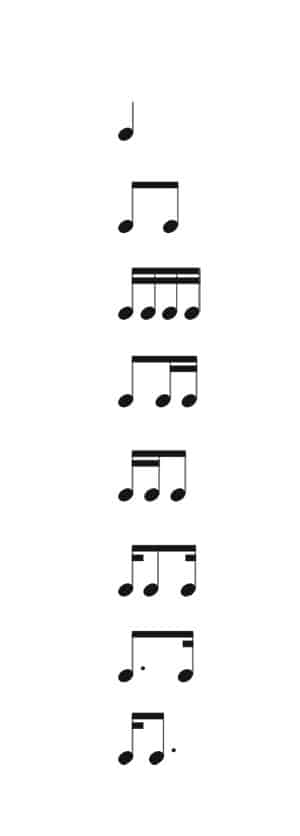
Pianists learn this coordination early in their studies and so should instrumentalists. This exercise makes playing in an ensemble much more accurate. Adding dynamics with clapping, starting with forte and piano as previously mentioned, is generally easier for young musicians than learning them while playing their instruments. You should also incorporate whole, half, and quarter rests early on.
For the warmup/etude section of the class, band books that feature rhythms and chorales are a good purchase for the band room. Working on a few exercises every class means that you are planting the seeds for a band that sightreads proficiently.
Etudes
Etude study helps students progress technically and musically. If students take private lessons, those teachers will select appropriate etudes. If not, imslp.org is an excellent source. Your college woodwind and brass textbooks also offer suggested etudes for each level. You can provide links so students can download exercises, or, if you have time, assemble an etude book yourself based on these exercises. For flutists, the works of Sussmann and Gariboldi are excellent and fun to play.
To round out the class, select repertoire that has something to teach. One of my students was so disappointed with her all-district music selections that she wondered if it was worth attending. She said, “Look at this piece. ABA form with the A sections being fast and the B section slow. The flutists only need to know five notes – Eb, F, G, A, Bb in the second octave. The A sections are in 58 and the middle section a slow three.” Granted she was an exceptional student, but I am sure on some level her observations were felt by others.
A band director friend was preparing his concert repertoire for an appearance at Midwest Band and Orchestra Clinic. His band played off-list in Texas, but for Midwest there is a requirement to program something for every grade level. He mentioned that polishing the music for grades 1, 2, and 3 was a challenge because the easier repertoire showed all of his band’s deficiencies. He took this as a challenge and sightread a grade 1, 2, and 3 level composition in each rehearsal.
If challenged and nurtured, middle school students can achieve musically satisfying concerts. Be patient and thorough. Reteach when necessary, and enjoy those moments of music making.