Midwest Clinic 2025
Set-Up to Warm-Up: The Nuts and Bolts of a Jazz Program
Bethany Robinson
Tuesday, December 16, 2025
1:00 PM – 5:00 PM
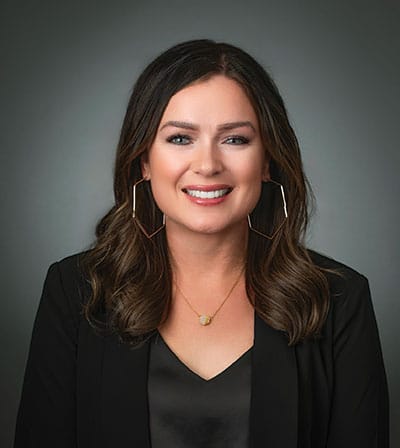
Bethany Robinson is excited for her role in a unique jazz clinic at the 2025 Midwest Clinic. She describes her session as hands-on and interactive. “I think people will leave feeling really inspired, really encouraged, and also connected to other directors who are doing the same thing. I think there is a lot of safety in numbers and reassurance that comes when you meet people who are sharing the same journey.”
What is the new jazz intensive that you have helped develop this year?
The event is broken into three sessions. The first covers the nuts and bolts of running a jazz program. The second part covers the transition from directing a concert band to leading a jazz band because so many directors face that situation. The third session focuses on jazz rehearsal techniques. I am excited that the rehearsal session will be a hands-on, bring-your-instrument clinic. We will have a rhythm section ready, and the amazing directors who attend the session will be the students in the band. In addition to experiencing jazz ensemble as a student, there will be plenty of time for questions and answers.
Who else is involved in making these sessions happen?
This is a collaboration between the Midwest and the Jazz Education Network. José Diaz, Midwest board member and President of JEN, and Kelly Bell, Executive Director of the Midwest Clinic, have been instrumental in developing this session. Besides me, the clinicians include Roosevelt Griffin, Director and Professor of Jazz Studies at Northern Illinois, and Mary Jo Papich, a legend in jazz education and a founder of JEN.
What provided the inspiration to schedule these sessions now?
This project came out of conversations at the Jazz Education Network conference, as we discussed ways to help a broad range of jazz educators at every level. Some directors think of JEN as just for college educators or professionals. The Jazz Education Network has education as part of its name, so we were looking to partner with the Midwest Clinic because it was the perfect way to reach even more directors at various levels of experience.
With my background as a bassist who played in jazz bands, you would think I would have been very well-equipped to teach jazz. Even though I had jazz experience from middle school all the way through college, I didn’t receive one pedagogy class through my music education degree. I thought that I was ready to teach jazz because I had played and listened to the music for years. When I went out and taught a big band, it was a disaster at first. Ironically, I took my band to jazz fest at Purdue University, where I am now the Director of Jazz. After we performed, I thought it was quite a success. When the adjudicator came up after, he just shook his head and looked disappointed. He said, “I guess we could talk about how to swing?” This comment was devastating to me. I realized how important it is to have that foundation in jazz pedagogy to get your students started.
Over the years, I have learned from conferences and attending clinics from amazing mentors who understand best practices for teaching jazz and building a strong jazz culture. Having worked hard to gain this information over a long time, it feels like a life mission to share what I have learned. This is true whether I am mentoring someone or inviting people into my high school classroom or at Purdue. These sessions at Midwest will give other directors the specific ways to show students what to do and how to get started.
What are some tips that directors will learn from these sessions?
Always have music playing when students enter your classroom. It might be arrangements you will play that day or anything that puts a professional sound into their ears as they put their instruments together. I always love playing a tune that makes them stand up and want to dance. Daily I’ll play a Joe Williams and Count Basie tune, which makes the players feel the time together. My other tip is to make sure that the hi-hat on two and four is really crispy. You want students to keep that heel up and really lay into the hi-hat. Make sure every student in the band is tapping their heel into the ground and feeling the time as well.
Finally, avoid playing the comparison game. If we are excellent at one subject, we can’t always compare it to a new subject we are just starting to learn. We must give ourselves some grace. Using our voice or our instrument, we might sit down and play along with the students. This can be really beautiful and collaborative as teacher and students learn the genre together, make mistakes, and try again. We can model what messy learning looks like.
Bethany Robinson is the Director of Jazz at Purdue University in West Lafayette, Indiana. She previously taught in the Noblesville (IN) School District where she expanded the jazz program from one to six bands. The top jazz ensemble was a two-time Jazz at Lincoln Center Essentially Ellington Finalist and Indiana ISSMA Jazz State Honor Band in 2023.
Solo to Ensemble: Harnessing Peer Power for Program Growth
Heather Henson & Randall Coleman
Wednesday, December, 17, 2025
2:00 PM – 3:00 PM
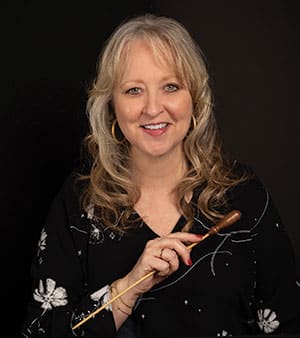
Heather Henson will share her experiences as the instrumental and choral director at American Christian Academy in Tuscaloosa, Alabama. Her session with conductor Randall Coleman, Director of Bands at the University of Tennessee at Chattanooga, will discuss the challenges of leading a small program and the many benefits of utilizing mentors. “Many people get into our field when they’re young and feel so overwhelmed with responsibilities and expectations. I would feel that way if I was just starting. The only way to survive that is to have these outside mentors and support.” Henson’s band from ACA will appear as the demonstration band for this clinic.
What was your path to becoming a director?
I am the product of a school in South Florida that had a program similar to the one I lead now. It was already developed and successful when I was a student. It had the typical levels of band and choirs and a thriving musical theater department, which we finally just added at my school last year, the next step in our long-term vision for fine arts.
I attended Samford University in Birmingham, a smaller university with a smaller music program. While completing my degree at Samford, I student-taught with Mike Tucker at the Pittman Junior High School program (now called Hueytown Middle School).
Mike Tucker is one of the best teachers I’ve ever seen or worked with. He had a larger program with 120 beginners broken into two classes. In my program, I am thrilled to get 12 beginners each year. Although most people think of me as having small groups, I do have experience with large programs, including helping with all-state bands every year.
When I began at American Christian Academy, in 2008, the elementary music classes were mostly comprised of singing. I wanted to develop a program that included comprehensive education on note reading, rhythm, and style. With the support of my headmaster, the band program began that year with five students after school. We slowly added to the program and created a vision for fine arts over a 10-year period.
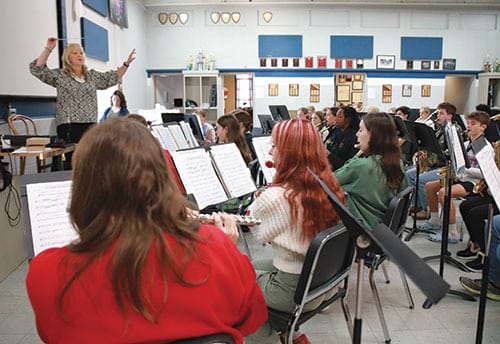
I have been here for 18 years now, and we have beginning and intermediate symphonic band, marching band, and choirs. About 10 years ago, they hired a second director to take over the elementary classes and help me with the band and choirs. We added a third position just this summer. It is so helpful to have our former percussion tech teaching full-time with me. All programs have challenges, particularly the smaller ones, so we have to be flexible and never quit. After 30 years in the field, anticipating small school obstacles and problems is one of my strengths.
What grades participate in your marching band and concert band festival group?
That is currently grades 8-12. We start them in 6th grade, have an intermediate band with 7th graders, and march with grades 8-12. Our goal is to have the 7th and 8th grades in an Intermediate Band, and then 9th-12th be our Symphonic/Marching Band. Requiring 8th graders to participate in marching is a struggle, which anyone in a program like this understands. We have 45 students in the top ensemble right now, 8th through 12th. The largest top group we have ever had at ACA is 63. We are still recovering from an administrative decision that restructured our middle school grades. This caused us to lose an entire grade of beginners, and then shortly after that were the pandemic years.
Your marching band recently competed for the first time in several years. What led to the decision?
We stopped competing for several reasons, but mainly because we only have four days a week to rehearse and one field on campus. Marching practice happens before school and during first period. We start at 7:40, and students have to be ready for a downbeat inside or to do breathing gym and stretching on the field. I have to let them go at 8:45 so they can clean up before their first class. It adds up to about 4-1/2 hours over four days each week.
The program really began to grow when I convinced the administration that band should meet first period. When making the pitch for band during first period, I reminded them that the football team practices more than 2 hours a day, five days a week. With less than half that time, we teach marching band, give concerts, appear in parades, and participate in a variety of community events. I didn’t have to convince families that marching practice before school was normal because they had never known any other way here. The parents trust me a lot here, thankfully. I told them, “You’re going to miss all the traffic if you arrive to school at 7:40.”
The decision to compete again was driven by my great senior class. They said, “Could we please go to a contest?” I explained the necessary commitment, and we added sectionals twice a week. Two different groups come at 7:15, a half an hour before the regular start time. The contest provided some additional motivation for students beyond the usual football games.
What was your initial motivation to apply for Midwest?
Midwest was never on my radar except to attend, and I had only gone twice because when I got back into band directing, I was a single mom raising three kids at stepping stone ages. I went to Midwest once with the Hillcrest band directors years ago and then when the Alabama Winds performed in 2017. Our band was ready for new challenges, and I wanted the program to keep growing musically and experience more than typical honor bands. They were ready for a higher level of performance.
How has this invitation motivated students?
When I told my adminstration that I was applying, they were all for it. Thankfully, my current headmaster has a bit of a band history. He supports the fine arts wonderfully across the board, so he was enthusiastic about applying to Midwest. I told him this probably isn’t going to happen the first year. He said, “Let’s figure out a way, if you get accepted, to get them there.” That statement made me feel confident.
My students had no idea what Midwest was. They get excited about traveling to a theme park, but inspiring them for this big conference took some explaining. When I told my headmaster we were accepted, he said, “I want the announcement to be big. I want balloons falling from the ceiling.”
There were no balloons, but we made a video and announced it in front of the school in the chapel. Everyone was very receptive. As for funding, we go on a trip almost every year. We alternate between bigger (and more expensive) trips and smaller ones. We wanted to take a bigger trip this year because of our great group of seniors, but flying to Chicago made it more expensive. Some of our families have taken on the fundraising challenges of this trip.
I normally am not too concerned with who decides to go on a trip, but we want correct instrumentation for any performance. For the Midwest appearance, I paid even closer attention to that. There were students who were not signed up, and the reason was definitely financial. We have had some small donors help out, and recently received a very large contribution from a family outside the band program for which we are very grateful.
For our clinic, I am pleased that we will demonstrate student mentoring by featuring our tuba section. I have never had to worry about having tubas at ACA, which is abnormal for a small school director. Years ago, I sent a young tuba player on a mission to connect with a beginning tuba student. They were probably five years apart in age, and the goal was to make a personal connection, not necessarily a musical one. Now we have a tuba family stretching over several years. They have long-standing communication groups, and they always ensure that the newest, youngest tuba player is brought into that shortly after they begin!
I am going to have the tubas demonstrate a scripted mentoring session to show what happens in my classroom when older students work with younger players. Then we are playing Robert W. Smith’s By Loch and Mountain, which has a great tuba solo and will pay tribute to Smith’s Alabama roots.
Our second piece is White Light by Phillip Sparke. It’s an oboe feature, and I have invited a former student, now in college, to play with us as part of a smaller ensemble.
The last piece we will play will be more poignant. We will talk about professional mentoring, colleague to colleague, professional and personal. I have had many mentors, but two of the most important are Randall Coleman and Leslie Welker, who is retired now, but she taught in this area. I got back into band directing after several years of staying at home with my kids. It was a very hard time, but it needed to happen. Leslie mentored me professionally as a band director, but also woman to woman. Our personalities are very different, but she motivated me to keep reaching for excellence even on the hard days. This is what band directors do.
I was talking with Randall back when I was first considering applying to appear at Midwest. He said, “you’re never going to know if you will make it unless you actually apply. You have to handle hearing the answer no once in a while.” That’s what we teach our students.
Heather Henson has been the instrumental and choral director at American Christian Academy since 2008. She graduated from Samford University with a Bachelor of Music in Music Education. She began teaching. She began her teaching career in the Jefferson County School System as the Assistant Director of Bands and Choral Director at Oak Grove High School and Alliance Elementary School, and then as Director of Bands at Pittman Middle School in Hueytown, Alabama. She is a clarinet player and was a charter member of the Alabama Winds.
– Interview by Becky Rodgers Warren
It’s A Small Band World After All
Roger A. Dekind
Friday, December, 19, 2025
3:45 PM – 4:45 PM
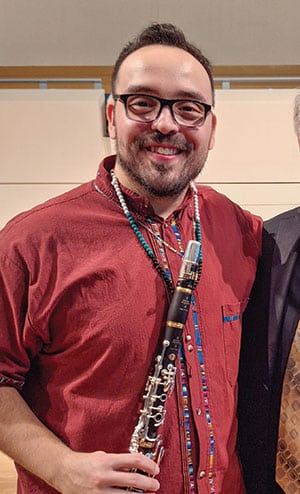
How did you get started at the Disney II Magnet School?
I was hired in 2018 just two weeks before school started. I did one round of interviews with the AP to the principal, took a tour of the school, and was offered the job in a couple of hours. They gave me a roster of 200+ kids, and they took me to a little closet in the main auditorium with 38 or 42 instruments. I had to figure things out on my own during the first year.
As a Chicago Public School alumnus, I came in with my roots in concert band and experiences at Lincoln Park High School and also as a student at the Merit School of Music. Merit is an outside program for music, but I call it the Hogwarts School of Music. That gave me the experience to go somewhere and build a more intense and focused training method for music.
I take everything that I have experienced and try to give my students great musical experiences. Our appearance as a clinic band at Midwest is an experience that has been years in the making. It’s a full circle moment for me, and I am excited for the kids most of all.
What grade levels do you teach?
For the last seven years I have taught grades 9 through 12. This year they mixed in some eight graders with the high schoolers. We have an opportunity to keep some of those eighth graders if they continue in band at the school. It is recruitment for our program and the school.
Describe the group you are taking to Midwest.
The group for the clinic is our Disney II advanced band. It is the top group in the school, but most of the students have only been with me for one to three years. I have never had a full classroom/group of students to start from Beginning Band and stay on the trajectory of Beginning, Intermediate and Advanced Band. Students come into band at any grade point and any musical experience. You almost always see students with very little to no musical experience and have a small window to work with to help them grow into the best musicians and humans as possible. The Chicago Public Schools have no feeder system. A neighboring district, for example, has two powerhouse high school schools that draw students from nearby middle schools with bands. We don’t have that in CPS.
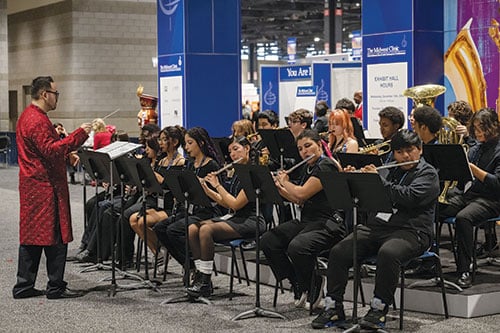
So, when you start your school year, you really don’t know who’s going to walk through the door.
Correct. I’m the only band instructor. So we just offer the three sections of band: beginning, intermediate, advanced. Maddy Marino, who is also a Roosevelt alum, teaches choir at the school. We share the same challenges of having a freshman class with little experience. As students in band or chorus make progress, we may bump them up to a higher level. We are assessing students throughout the year. We have been fortunate that the school secretary or scheduling coordinator works with us to make these ensemble changes possible. It is so important to have those relationships.
What was your first experience with the Midwest Clinic?
I was blessed enough to be a senior at Lincoln Park High School in a selective enrollment music program that was one of the top programs in the Chicago Public Schools. A clinician came in, and our jazz band played some jazz techniques. As a result, our band was selected to go to Midwest. We worked with some top jazzers in front of an audience at Midwest, similar to what we are doing this year. It was thrilling to play in a place where every famous composer and conductor was in the building. That was such a huge moment because CPS is rarely featured at such a prestigious clinic, even though it has been held in the same city for almost 80 years.
How will Midwest impact your students?
This has been the driving force since the day I got hired. I knew what Midwest is, and the impact it has. It didn’t just change my life; it changed every person in band with me. At the convention, students will have a chance to try a professional instrument and to hear top-notch musicianship from everywhere. Everyone deserves to get that experience and cherish that moment. I continue to preach to my kids that there are so many great experiences outside the walls of our school.
In the last couple of years, I have attended for two days and have brought my students along for a day. This year, they will spend two days at the conference. We will check out performances and explore the exhibit hall. I have told them, “Every university is here at your fingertips. All of the big schools are coming to you. It is a chance to think about your future and what you want to do.”
What will directors see at your clinic?
The first half of the clinic will focus on thriving as a small band program in the fourth largest school district in America. We are a magnet school but also tied to a neighborhood school. We do not have the benefit of selective enrollment in our district. I am going to tell the story of how we got organized and jump started a program just two weeks after being hired. The second half will demonstrate our approach to teaching music and our rehearsal process.
Since we first received this invitation at the start of the year, my message has been: You are representing something bigger than CPS, bigger than yourselves. We are here to highlight those beautiful things that happen in our program and represent the school and city. We are here to serve.
Roger A. Dekind is the Band Director/Music Instructor at Disney II Magnet High School, where he has taught for nearly eight years. He is a graduate of the Chicago College of Performing Arts at Roosevelt University with a major in music education. He has studied clarinet under Dr. Bonnie Campbell and Charlene Zimmerman. He describes the Disney II band community as united, supportive, energetic, and dedicated and credits his students for pushing him to become an even better director and teacher.
– Interview by Becky Rodgers Warren
Day Two: Next Steps for Success with Your Beginning Jazz Band
Antonio J. García
Wednesday, December 17, 2025
1:30-2:30 PM
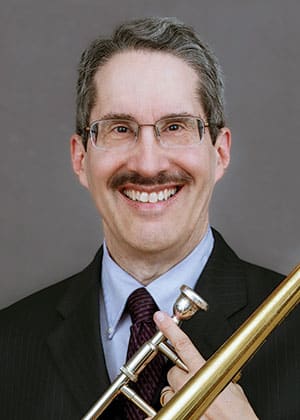
At The Midwest Clinic, we have had a real interest in presenting the attending educators with information they can grab onto and use day one in rehearsal. There are a high percentage of workshops to help them when they march into the band room on the first day of the semester. We set up a jazz track to focus on day one for a beginning jazz band at any level from middle school up to a college. What could you do on day one, week one?
There will be demonstrations with a hands-on pair of workshops where clinicians work with a demonstration middle school jazz band for two hours of a three-hour presentation. The third hour, held on a separate day will have a pair of clinicians discussing how to make the decisions behind the desk before you get to your first rehearsal. These choices might range from budgets to repertoire to amps.
The clinicians for day one, José Diaz and Dick Dunscomb, will demonstrate strategies that focus on getting a swing groove across the band because swing is the most amorphous of all our grooves for many people. There will be discussion on jazz articulations and listening to some recordings.
After a 15-minute break, Don Zentz, also a Midwest board member, and I will lead the day two session. We will demonstrate strategies for using call and response vocals, teaching improv, and layering in things for performance. The demonstration band, from Old Quarry Middle School, directed by Frank Alongi, will perform at the end of that second hour of rehearsal.
The next day, two great in the trenches educators, George Andrikokus and Matthew Johnson, will give a session called Before Rehearsal: Planning for Your Beginning Jazz Ensemble. They will walk through the decisions that directors make regarding stage setup, literature choices, lesson plan, and emphasizing what might be called ensemble-ship partnering with musicianship.
What led to this deep focus on jazz this year?
It was just a confluence of great things. The Pre-Conference Intensive is a cooperative effort between the Jazz Education Network and Midwest, and all of the jazz members of the Midwest Board are members of JEN. We’re actually giving a workshop at JEN from our Midwest standpoint. We call it A Prescription for Success and offer suggestions to help jazz directors take their ensembles to the next level. There’s always a need to help foster the next generation of jazz bands. It’s important continually to fertilize the ground and water it and make sure that we are constantly bringing up stronger ensemble experiences and band and orchestra directors who have the information they need to grow with the confidence to experiment.
For many band directors, jazz is an experiment. We know that most music education degrees don’t include any jazz requirements. Most music educators who graduate from great programs have no experience putting together a jazz curriculum or teaching improvisation. There are also other great musicians who are running jazz bands who are hungry for more information. We try to provide that.
At some point, jazz comes up for most school directors. They may have a holiday concert or swing or pops music for a concert. Having the proper interpretation is important to them in their regular job, if that regular job isn’t jazz. They want to sound as authentic as they are with Mozart or Persichetti or anything else that crosses the desk. They don’t want to play a tune by Duke Ellington and have it feel uncomfortable. The notes for jazz charts are the same black and white shades as the notes for classical charts. The only thing that changes them is the interpretation which comes from listening. It sounds simplistic, but it is true.
If someone is hungry to learn about jazz, the educators who have deep experience are happy to help. We can tell directors what to listen to start students off on a bossa nova, a swing tune, or a blues. We want to help younger directors build that foundation and could explode the amount of informed music educators. The Midwest Learning Channel is another valuable resource for directors. It is a growing archive of videos of various workshops that can be accessed at midwestclinic.org.
I want to emphasize to anyone reading this that they can contact me or any established educator who might be helpful. The secret sauce is listening to the music we want to emulate. Singing along with the music is also essential. If you can sing along with the phrasing of the Basie band or sing along with Ella, you will figure out how to articulate that with your instrument and band.
Antonio J. García is Secretary for the Midwest Clinic and has served on the board for three decades. He is former Director of Jazz Studies at Virginia Common-wealth University and an alumnus of the Eastman School of Music and Loyola University of the South. He is active as a performer, composer/arranger, producer, clinician, educator, and author in instrumental and vocal genres. www.garciamusic.com
– Interview by Kevin Schoenbach
You Cannot Teach an Empty Chair: An Affirmational Approach to Recruitment, Retention, and Representation
Chandran J. Daniel
Thursday, December 18, 2025
1:30-2:30 PM
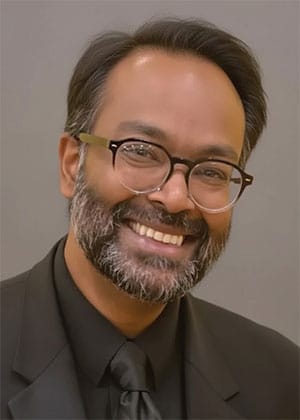
I’m in my 18th year of teaching. I’ve taught in urban schools, parochial schools, small schools, and large schools. It is easy to get hung up on all of the resources you are missing, but teaching at a small school has taught me that the greatest resource is the students in the room. You can’t teach an empty seat to cover a tuba part.
There are a handful of concrete steps that anyone can take, regardless what their program looks like to increase recruitment and retention. Start by taking a look at your total population demographics and think about how to use that to direct your efforts. It’s really important to examine all of the data available to see who is in the room, who is missing, and reflect on the challenges students are facing and what you can do to assist them.
Students
Find ways to connect with students quickly and affirm why you want them in your program. They need to have a reason to sign up. For some, it’s just a love for playing instruments, and they already have this appreciation for music. However, for students who haven’t connected with music yet, you have to find ways to bridge that gap for them. All of your great pedagogical tools have zero impact on students who are not in the program.
At a previous job, I was a K-12 music teacher at a small school and oversaw the band and choir programs. The total student population was about 180 kids from kindergarten through 12th grade with only 55 high school students. During one of my first classes with the high school choir, there were a couple of boys who were disruptive and just would not pay attention. I reached this point of great exhaustion and frustration and thought, “They are new to this program, and this is not a good fit. I need to have a conversation about them finding something else to do with their class period.” Then, I just had this sinking feeling in the pit of my stomach; if I kick them out, where does it stop? I realized that with so few kids in the building, I needed to change my mentality and attitude. How many kids would lose out on the opportunity to experience music, if I kicked them out because our personalities did not agree. I needed to think about how could I serve these kids. That was the moment when I came up with the phrase, “You cannot teach an empty chair.”
I had to find a better way to connect with them, meet them where they were, and keep them in the room, which ultimately did happen. One of them was the captain of the basketball team, and the next semester he recruited six or seven more boys to join choir in this tiny school.
Equipment
When I worked in low SES (socioeconomic status) schools, getting instruments was often the biggest challenge. I taught at a charter school on the west side of Chicago for six years in an under-resourced community, so a lot of my research and presentations in the early part of my career were focused on building band programs in low SES situations.
A few years ago, Dr. Ken Elpis was presenting at IMEC, and he made this brilliant point that really stuck with me. When schools were transitioning towards computers, one of the biggest challenges they found was that many families could not afford to have a personal computer at home. The most effective solution was often for schools to just buy computers and make sure that everyone had the equipment they needed. They didn’t allow the resource gap to be an insurmountable challenge that would keep students away from these necessary 21st century skills.
For instrumental music programs, the cost of entry often comes down to whether students can afford instruments. Sometimes the most effective strategy is to just “buy the computers,” to get the equipment kids need and eliminate as many barriers as possible so students can have access to a high-quality music education. Sometimes we just have to take a deep breath and figure out how we can find more resources. The great thing I have found, however, is that when you invest in breaking down barriers towards access, it tends to create long-term instead of short-term solutions.
As you gain equipment, you gain personnel. As you gain personnel, you tend to gain monetary resources to reinvest. If you can start to increase your enrollment, you are also increasing your fundraising base. Every student that you bring in is another person to help with the fundraising burden. It becomes a positive cycle. As you start adding equipment, you add more bodies, and you very quickly have a positive curve to your fundraising and resource building outcomes. It also becomes easier to make your pitch to administrators and the community when they see positive growth in quality and the number of students who are impacted by the program.
There are lots of small steps to take to begin building an equipment inventory. You might start with small fundraisers to buy inexpensive instruments from Facebook Marketplace, local pawn shops, garage sales, or flea markets. Something that was really effective for me was working with local music stores to get multi-year leases for 30 instruments that we would pay off over three or four years. This gave us equipment in hand and a specific fundraising goal every year to pay for those instruments. At my school in Chicago we did this and were able to quickly build the band program up from 8 students to 50 after three years. By the time I left, there were 85 students in the band program.
At the school I’m at right now, Thompson Junior High School, there were about 140 kids enrolled in the band when I was hired four years ago. Today, we have a little over 240. Students are the lifeblood of a program, and you need a well-planned approach to recruitment to keep your program vibrant and growing.
Chandran J. Daniel is the director of bands at Thompson Jr. High School for SD 308 in Oswego, Illinois. This year marks Daniel’s 17th year of teaching. His previous positions (all in Illinois) include K-12 music director at the Hinsdale Adventist Academy, K-8 music director at the Alain Locke Charter School in Chicago, and band director at Lincoln Middle School and Edwardsville Community High School in Edwardsville. Daniel received his Bachelors of Music Education from Illinois State University and Masters of Music in Music Education from Anderson University in Anderson, SC. Daniel was named as a 2017 Emerging Leader by the Illinois Music Education Association Board of Directors.
– Interview by Kevin Schoenbach
Join Us For This Historic Meeting!
NASSB: National Association of Small School Bands
In 2015, it became apparent that there was a large contingency of attendees at The Midwest Clinic who taught at small schools. Richard Crain, president of the Clinic’s board of directors arranged for a session featuring four small school directors. An attendee at this session stated that she had been coming to Midwest for 25 years, and this was the first clinic whose subject matter was dedicated to addressing challenges unique to small school band programs. Later, Frank Troyka presented a marching band clinic for small band programs and it was SRO.
Over the years, most clinic sessions at The Midwest Clinic have been directed toward larger band programs, often those with significant resources. Even though many doubted the wisdom of creating special tracks directed toward a specific audience, the Small School Band Track was created. By any standard of measurement, these sessions have attracted full audiences. In a 2024 survey, this overall subject received the most requests.
Richard Crain, president of The Midwest Clinic Board of Directors from 2009 until 2021, grew up in a small school band program with a high school enrollment of 75 students, and he was a major influence in campaigning for these special tracks. According to Crain, “The opportunity to learn to play a musical instrument and experience the joy of making music together literally changed my life.”
In 2002, the Holiday High School Band from Holiday, Texas auditioned to perform on the main stage and received an invitation to present a concert at the 56th Annual Midwest Clinic, Chicago Hilton and Towers. Since that first performance, 12 small school programs have been invited to present a concert or clinic at Midwest.
In 2024-25, the thought of creating a national organization to formalize and organize information to provide tangible assistance to small school programs was developed. This organization would exist as a resource center, a platform to exchange ideas, and a tangible effort to address the unique needs of this special classification of schools nationwide. This endeavor is not about dues or generating revenue. It is a genuine effort to address the needs unique to rural and other school programs with small enrollments. All students deserve to learn to play a musical instrument!
We are grateful to The Midwest Clinic for providing the room (Prairie Room, Thursday, 8:30 PM) and advertisement of this meeting. Gratitude is expressed to Rebecca Warren (North Dakota) and Stan Mauldin (Texas) for their leadership in the development process for the establishment of the NASSB. Our appreciation goes to The Instrumentalist for featuring the NASSB as the 79th Midwest Clinic approaches!