The first day as a teacher is nerve-wrecking and thrilling. I waited my entire life to have my own classroom. I work hard, make inevitable mistakes, and pursue my calling. It sounds cliché, but there’s an unexplainable joy that accompanies the opportunities to advocate for yourself and help others grow each day. I have always wanted to be a teacher and never considered another career path. It is the honor of my life to be the same influence on students that many of my teachers were for me. For those teachers just starting their journey, the best is yet to come.
One of the hardest parts of the first few years is learning what you don’t know, but you will also be surprised by how much you will learn and how much you already know and can do. Here are a few tips that guided me through my early years on the job. Use what works for you.
Make your presence known. More than likely, you will meet your administrators before the school year begins. Your admin will probably introduce you at the first faculty meeting of the year. Once the school year starts, everyone has their own responsibilities to help make the school run (including you). The faculty, staff, and students will know your role as the new music teacher, but it’s your responsibility to make sure they know you as a teacher and as a person. Introduce yourself to others. Make friends with your co-workers. You need to be the biggest advocate of the school’s support staff (so the relationships reciprocate). Talk to students in the hallway during the passing period, even ones that you don’t teach. Put yourself out there. The buy-in to you and your program will be invaluable.
Establish systems, procedures, expectations, and love from day one. Fun, high expectations, and care can exist together. It is imperative for students to know and be able to explain the importance of the music room. It one of the most special places on campus. The room carries a history of hard work, a culture of excellence, and lots of expensive equipment in the room. You should establish how to operate in your classroom and hold true to it before students ever step inside. With beginner band classes, we meet the students outside of the room before entering on the first day. We greet them warmly, make them feel welcome, and give them a brief set of directions for how to enter the classroom. If students do not meet the expectations upon entering the room, everyone exits, and we all try again. We do this as many times as it takes. Once the students demonstrate the entrance procedure that we expect, we celebrate.
Children are inherently good, want to please you, and will do anything for praise or an incentive. We repeat this process each day for the first ten days of the school year. Repetition then becomes habit. All other expectations for how to act and work in the music room are an extension of the tone we set from the first day.
We emphasize that our expectations, both very high and non-negotiable, are not intended to be mean. It is simply the way we do things. We tell students what we expect from them and what to expect from us. Our expectations beyond this follow a simple principle: “here is what we will never do, and here is what we will do always.” Setting and reinforcing this standard each day will pay dividends when it’s time to begin making music.
Create a daily instructional planning method that works for you. Pacing real-time teaching is challenging. It’s a work in progress forever. Not only do we decide what to teach, but also when and how (a superpower of our discipline). I have found that each class is different based on several factors: the course and its content, the size of the class, and the personalities of the students. In our teaching scenario, our large class sizes dictate how we approach instructional delivery: fast paced and tightly regimented. We over-plan for all of our classes. You need to schedule more than enough activities to avoid running out of things to do.
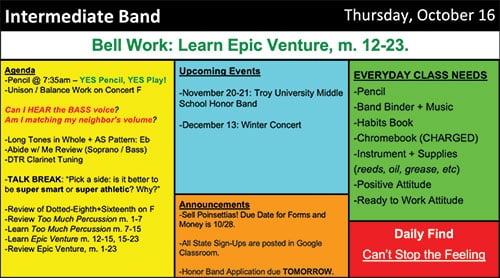
You don’t have to accomplish everything planned in one class, but be strategic about how it affects the next set of classes or rehearsals. By doing this, you minimize downtime and potential behavior concerns while maximizing instructional time. Having a written plan of some sort will keep you on task, which transfers directly to the students. I have included a slide that our second-year band students see at the beginning of each class. It includes all announcements and important information, the class agenda, reminders, and other fun finds to help engage students throughout class.
Build relationships with everyone. Learning your students’ names is crucial. Whether you have 15 new students or 250, learn their names as fast as possible. Refer to students by name and high five them in the halls.
Communicate with parents in various formats. Send home a weekly or quarterly newsletter letting parents know about upcoming events or what’s happening in class. Include pictures of their kids having fun. Copy your administrators on these emails to keep them in the loop.
Invite teachers to visit you teaching while they are on their planning period – they love to see you and their students in action.
Take time to visit and chat with the main office, nutrition, and environmental staff.
Walk through the lunch room and chat with students and colleagues during lunch. The more ways that you can connect with supporters, the more support that you will receive.
Develop and rely on a support system. You need friends, mentors. co-workers, and the presence of other adults. It helps to chat about the daily grind. Sometimes you just need to vent, and at other times just to talk about fun things unrelated to teaching.
If you can, go eat lunch in the cafeteria with other teachers. This gets you out of your classroom. Stop by and engage with other staff members on your campus – talk to them and listen to them. Ask one of the assistant principals what they did over the most recent school break.
Building this community is vital to balancing your identity as a teacher and and a person. After all, this rewarding work has enough challenges. One of its many highlights is the chance to connect with fun people who want to support you as much as you are willing to support them.
Mentors. Good mentors are important to your success. Most schools assign on-campus mentors in the early years. Regardless of whether they are in your content area or not, try to learn as much as you can from veteran teachers. Their wisdom and experience provides perspective based on years in the classroom.
When you can, make time to visit with them and if possible, observe them teaching a class. Take notes on more than just the instruction – notice their pacing, proximity, tone, and how they manage the room. Be open to having them observing you during a lesson. Even teachers outside of our discipline have great ideas on how to interact effectively with students in meaningful ways. Plus, the best mentors will help you work through challenges and retool strategies to better teach concepts and engage your students. Working with mentors can lead to life-long relationships with people you admire, and respect.
Reflect. Reflect on your successes and mistakes. Sometimes you will know immediately when something has gone well or poorly. Other times, the results of your efforts will appear when you least expect it. As a very young teacher, I found myself only praising the students who behaved well, while only scolding the students who did not. I did not acknowledge the moments when a typically misbehaving student did something well. This led to those students being seen as outcasts in comparison to the students who followed the expectations. Over time and with reflection, I have made a conscious effort to recognize all students for all positive behaviors, which has yielded a positive impact on the teacher-student relationship in my classroom.
You should continue to gain all of the knowledge that you can. Recognize your strengths and what you do know – use this to your advantage. Be honest with yourself about your weaknesses and what you don’t know. There are no overnight fixes, only long-term solutions. As you get older, gain more experience, make more friends, and go through more trial and error, you will inevitably grow. You will learn what works and what doesn’t.
Go home. The work we do is taxing, rewarding, and busy. Often, we arrive at school with a list of tasks to complete and leave having only accomplished a few of them. As we learn and improve, we become more efficient, but our list of responsibilities will continue to grow as well. You can not do your best work if you are not well rested. It’s so easy to work late, but it will all be there tomorrow. Make time to enjoy yourself, your family, and leisure as much as you can.
Become a household name. When students get home from the first day of school, you want to be one of the first names that they mention to their parents. Your enthusiasm, care, high expectations, and fun will hopefully have left such an impression on them after one class that they can’t wait to tell others. Students join music programs because their friends do or for an excitement about music. You are the reason that they come back.
Twenty years from now, you want former students to look back on school and mention how awesome you were for them. Greet them at the door with a smile. Learn their names and use them. Be invested in their interests. Watch the travel softball games even when you don’t want to go. Make it a big deal and over-celebrate with students when they do something well.
Your career is a marathon, not a sprint. My friends and colleagues remind me of this daily.
Change takes time.
Learning takes time.
Growth takes time.
Success takes time.
You are in for a fantastic school year. Make the best of every moment.