Thoughts on Creative Concert Programming
Selecting repertoire is one of the most challenging tasks directors face. Creative parameters, such as artistic themes or extra-musical events, can guide repertoire selection and enhance the meaning of the program. However, directors may worry that overly broad programming may require purchasing or renting music beyond their budget or planning time. This article suggests ways to design concerts that are budget-friendly and creative beyond traditional programmatic formulas. I will illustrate how each strategy guided the concert programming for the Augusta University Wind Ensemble (AUWE) 2024-2025 season.
That ensemble had 58 members with approximately 50% music majors and 50% majors outside of music, along with several outstanding local high school students. The AUWE had complete and balanced instrumentation, performed primarily grade 4 and 5 repertoire, and rehearsed twice a week with 100 minutes for each rehearsal and an average of 12 rehearsals per concert cycle. The concert examples below can work for a wide range of ensembles and demonstrate ways to think creatively about programming while staying within reasonable music purchase budgets.
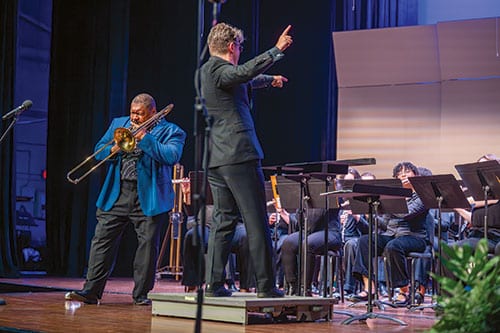
Professor Wycliffe Gordon, Director of Jazz Studies at Augusta University, performing with the Wind Ensemble,
Photo by Michael Holahan, Augusta University
Establish a Framework
A blank canvas is daunting to any artist. Establishing an initial set of creative guidelines can start the brainstorming process, whether planning a single concert or a multi-concert season. For example, these parameters might include art movements or styles, emotions, or topical or social commentary. I review programs from other institutions, consult with trusted colleagues, read the culture section of newspapers or classical music periodicals such as Gramophone Magazine, and spend time in art museums and nature for inspiration.
I also explore connections to other departments on campus and community organizations. For example, a school with a strong dance program could facilitate a collaboration on a piece, while a connection with a rap artist could lead to a performance of a piece for rapper and wind ensemble. In practical considerations, the technical capabilities of the venue (lighting, projection, digital display, stage size/setup) determine what and how to implement the creative limits. All of these ideas are part of the brainstorming process.
For the 2024-2025 season, I chose Vox Humana (The Human Voice) as a unifying framework, establishing that any music related to singing or folksongs would fit the theme. The collaborative potential was straightforward with faculty vocal colleagues, and there are many pieces that connect to the theme. In programming during the season, I connected at least 2-3 pieces of each concert to the overarching theme. This provided a clear thread throughout the season.
Use Stand-Alone Concepts
The next step required thinking about concepts, activities, or ideas related to the established framework. These adjacent facets expand on the main theme and provide more texture. For Vox Humana, I identified concepts related to the human voice, from obvious (singing, music based on songs) to less salient (different folksong traditions, the interaction of songs in a piece). This led to ideas for the stand-alone concerts (two per semester), with each concept relating to the overall theme.
The first concert was based on the mashup approach when an artist takes two or more melodic ideas and simultaneously transforms them. When selecting pieces, I first searched our library and found three pieces that fit the concept. Michael Markowski’s joyRiDE, a mashup of Beethoven’s Ode to Joy and John Adams’ Short Ride in a Fast Machine, was the concert opener. Charles Ives’ The Circus Band March was the closing piece and displayed his idiomatic layering of popular songs. While not a conventional mashup, Folk Song Suite by Ralph Vaughan Williams, served as the anchor cornerstone repertoire for the program. These three pieces established the initial concert structure with an opener, main work, and closer. Next, I looked for other music to complete the program. Two familiar works – Omar Thomas’ Shenandoah and Shelley Hanson’s Volver a la Montana – are reimagined settings of different folk song traditions from the Americas. In addition, I wanted to feature a trombone faculty colleague and selected Arthur Pryor’s arrangement of Annie Laurie because of its parlor song source, which complements those found in The Circus Band March. The resulting program was balanced in diversity of composer voice, style, genre, and era, and totaled 38 minutes of music. Because my school owned half of the selections, the cost was under $300 for the additional repertoire.
Concert 1: Mashups
joyRiDE, Michael Markowski
Shenandoah, Traditional arr. Omar Thomas
Annie Laurie, Alicia Ann Scott arr. Arthur Pryor
Folk Song Suite, Ralph Vaughan Williams
Volver a la Montana, Shelley Hanson
The Circus Band March, Charles Ives
Be Flexible and Adaptable
Programming takes time to sift through repertoire lists, listen to ideas, and revise plans with a fresh perspective. Often, the process becomes rushed, with selections made close to the start of a concert cycle. Planning for the 2024-2025 season started in late November 2023 and was nearly completed by May 2024. That time-frame gave me flexibility to adapt as new opportunities arose, which was evident in our first concert of the Spring 2025 semester.
My initial plan for this concert featured two faculty members, one woodwind colleague on shakuhachi (a traditional Japanese flute) for Tetsunosuke Kushida’s Figurations and a piano colleague for Gershwin’s Variations on I Got Rhythm. Chen Yi’s Spring Festival, which incorporates the traditional Chinese folksong Lions Play with the Ball, opened the concert, and Ron Nelson’s Courtly Airs and Dances was slated to close the concert. Despite careful planning, the program felt incomplete.
In April 2024, my colleague Wycliffe Gordon inquired about performing one of his compositions, Me, We, with the Wind Ensemble during the 2024-2025 year. The Spring 2025 concert already had two featured artists, and Wycliffe was a natural addition to the program. The title, Me, We became the concept for the concert as a play on words: Me (the soloists) and We (the Wind Ensemble). Plus, his composition and showcase were a great finale.
During Fall 2024, I learned more about the group’s playing ability, and decided to feature students as a complement to the faculty to align with the Me, We concept. Our library had John Mackey’s Strange Humors, which includes a significant djembe part. The featured students were two percussionists, so I doubled the djembes and staged them antiphonally in front of the ensemble. Adding Strange Humors helped to round out the concert program.
After an initial read-through of the program, it was clear that Courtly Airs and Dances was not the right challenge for the ensemble, and the piece would plateau halfway through the rehearsal cycle. The program needed a new anchor piece of similar duration. I chose Satoshi Yagisawa’s Machu Picchu: City in the Sky to read from the library. Though the piece was considerably more difficult than Courtly Airs and Dances in the initial reading, it provided the technical and musical stretch to push the ensemble’s ability and musicianship. The final program only required me to purchase two pieces at less than $250 total, and it provided a challenging yet rewarding experience for the ensemble.
Concert 3: Me, We
Spring Festival, Chen Yi
Variations on “I Got Rhythm”, George Gershwin trans. Douglas McLain
Figurations for Shakuhachi and Band, Tetsunosuke Kushida
Strange Humors, John Mackey
Machu Picchu: City in the Sky, Satoshi Yagisawa
Me, We, Wycliffe Gordon
Tie It All Together
The season’s final concert summarized the Vox Humana theme. The concert was a shared performance with the Greenbrier High School Wind Ensemble, the top band at a local school. They performed on the first half of the program. The core of our portion centered on composers’ reimaging of folk songs. We opened with Percy Grainger’s The Duke of Marlborough Fanfare and created a chamber music opportunity for more advanced brass players as well as a solo feature for a talented horn member. Dwayne S. Milburn’s American Hymnsong Suite anchored the program while Andrew Boss’ A la Machaut closed the concert and served as a capstone to the season with its modern reimagining of Guillaume Machaut’s melodies.
During the 2023-2024 academic year, Augusta University hired a new voice faculty and opera program director, and I wanted to feature her with the band during her first year. Bernard Gilmore’s Five Folk Songs for Soprano and Band was a good fit for her and the ensemble. The concert needed one more piece to round out the program. Because the concert was scheduled for the Tuesday after Easter Sunday, Sousa’s Easter Monday on the White House Lawn was a subtle nod to the timing of the concert. The Department spent $270 on new music for this concert.
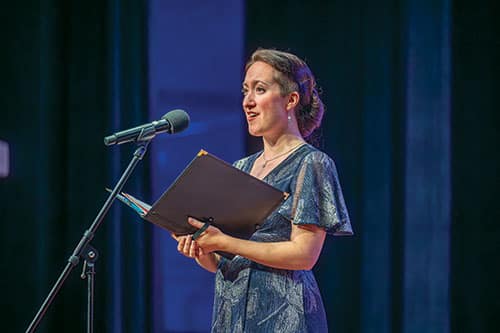
Dr. Courtney Kalbacker, Director of Opera Theatre at Augusta University, performing with the Wind Ensemble,
Photo by Michael Holahan, Augusta University
Flexibility in programming is vital since unexpected opportunities may arise that alter the intended concert. For example, in early Spring 2025, I was asked to have the Wind Ensemble perform for our new university president’s inauguration, planned for the same week as our final concert. After discussion, we made our pre-existing concert part of the Inauguration Week celebrations, which meant he, his family, other university leaders, and local dignitaries would attend. Our President played trombone in middle and high school band, which opened opportunity for meaningful connections in celebrating the inauguration while acknowledging his musical background.
Given the President’s trombone experience, I arranged for Wycliffe to perform Me, We as a surprise encore and musical treat. Many stars aligned for those added selections to work, yet it required little extra rehearsal time and elevated a historic moment in our institution’s legacy. None of that would have happened without nimble programming and the established framework for the season.
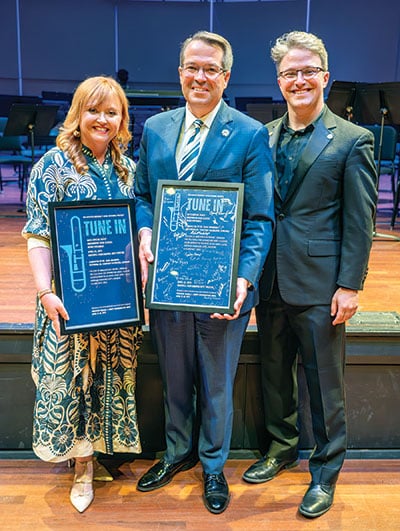
Dr. Russell T. Keen and Karen B. Keen, President and First Lady of Augusta University, with the author,
Photo by Michael Holahan, Augusta University
Concert 4: Tune In
The Duke of Marlborough Fanfare, Percy Grainger ed. Donald Hunsberger
Five Folk Songs for Soprano and Band, Bernard Gilmore
Easter Monday on the White House Lawn, John Philip Sousa
American Hymnsong Suite, Dwayne S. Milburn
A la Machaut, Andrew Boss
Alma Mater, Robert W. Smith
Me, We, Wycliffe Gordon
Planning repertoire can be a daunting task. Establishing a framework, whether for one concert or an entire season, can foster creative ideas about repertoire. Within that structure, concerts can center on different concepts related to the framework, broadening how pieces relate back to the concerts and framework as seen in Concert 1. Planning over a long period of time gives room for many program drafts, while openness to flexibility allows for adaptability based on the ensemble, as seen in Concert 3, or to incorporate new opportunities as seen in Concert 4. The Augusta University Wind Ensemble’s programming was achieved while spending less than $1,000 on new music for the year. I hope these examples inspire creativity as you develop programming your concerts. If you have questions or comments, please feel free to email me at ibrinberg@augusta.edu.